

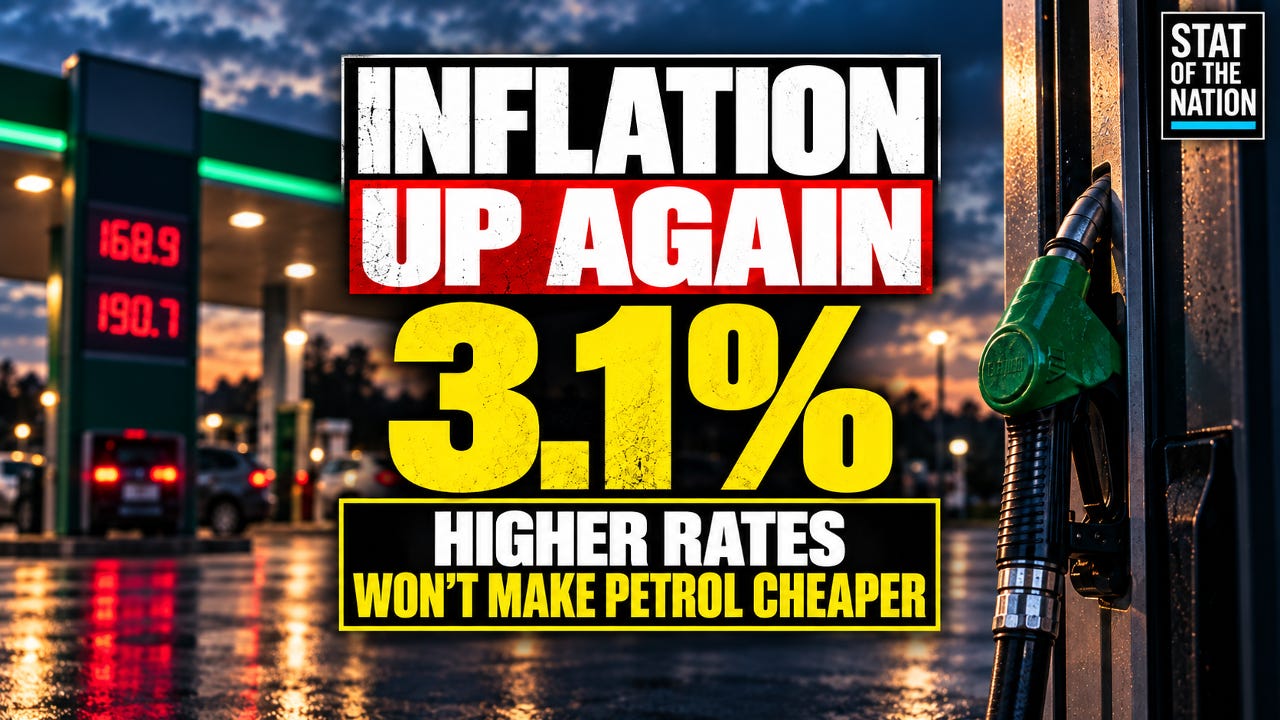
UK inflation is rising again. The Consumer Prices Index increased from 2.9% in July to 3.1% in August, putting inflation further above the Bank of England’s 2% target.
But the headline number only tells part of the story. Look underneath it:
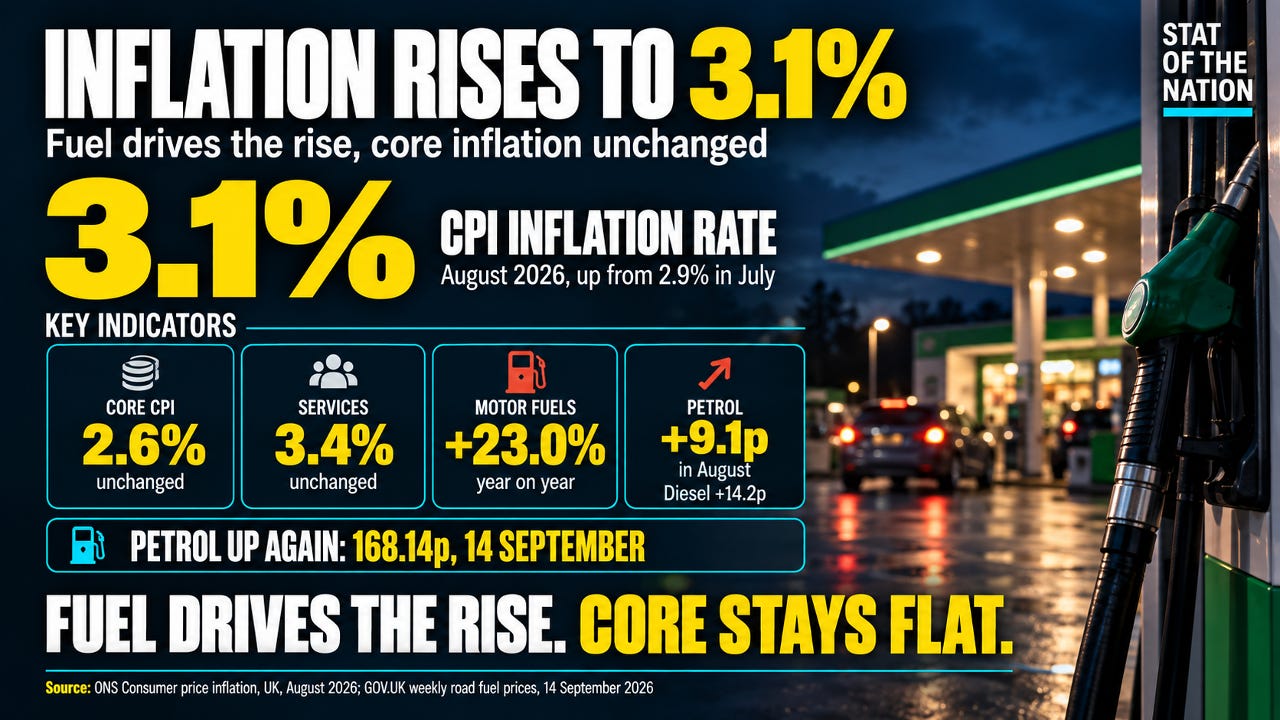
Headline CPI: 3.1%, up from 2.9%
Core CPI: 2.6%, unchanged
Services inflation: 3.4%, unchanged
Motor fuels: up 23.0% year on year
The Office for National Statistics says transport, particularly motor fuels, made the largest upward contribution to the increase in inflation.
There is little sign in the August figures of a broad acceleration in underlying inflation. Core inflation did not rise and services inflation did not rise, while fuel prices surged.
The immediate increase therefore looks much more like another energy shock than an economy overheating because British consumers are suddenly spending too much.
Petrol Is Driving Inflation Higher
Between July and August, average petrol prices rose by 9.1p per litre, reaching 161.3p. Diesel increased by 14.2p, reaching 181.8p, while motor fuel prices overall were 23% higher than a year earlier.
The problem is that those figures are already looking backwards.
Official weekly data show average petrol prices had risen again to 168.14p per litre by 14 September, while diesel had climbed to 190.72p. That is around another 7p on petrol and almost another 9p on diesel compared with the August averages.
If those prices persist, fuel could remain an important upward pressure on September’s inflation figures.
Headline inflation could therefore rise further without British households suddenly demanding more goods and services. That distinction matters, because the reason prices are rising determines what different economic policies can actually influence.
Petrol Doesn’t Just Affect Your Car
Higher oil prices do not stop affecting you when you leave the petrol station. Almost everything we buy has to be manufactured, transported or delivered, which means energy costs work their way throughout the economy.
Hauliers use diesel, supermarkets operate distribution networks, manufacturers consume energy and businesses pay to move raw materials and finished goods. When those costs rise, firms may initially absorb part of the increase through lower margins, but some will eventually be passed on.
The Bank of England itself separates this into direct, indirect and second-round effects.
The direct effect is immediate, petrol, diesel and other energy prices rise. The indirect effect comes as more expensive energy increases the cost of producing and transporting other goods and services.
The Bank’s own September intelligence from businesses is already seeing that process. It reports higher freight and fuel costs, higher energy-intensive input costs and firms passing on part of those increases, although weak demand and competition are restricting how much they can raise prices.
That is an important distinction.
If a product becomes more expensive because diesel, freight or manufacturing costs have risen, its price has still gone up. But that does not automatically mean consumers are demanding too much of it.
The cost of supplying it has increased.
So What Would Higher Interest Rates Actually Fix?
This is where the interest-rate debate becomes much clearer.
The Bank of England itself says that “monetary policy cannot influence energy prices.”
Increasing Bank Rate cannot produce more oil, increase refining capacity or directly knock 10p off the price of petrol.
What higher interest rates can do is weaken demand. Mortgages and other loans become more expensive, businesses face higher financing costs, investment becomes less attractive and households have less money available to spend elsewhere.
That mechanism has an obvious role when an economy is overheating because demand is running ahead of supply.
But where is that evidence in these inflation figures?
Core inflation is unchanged.
Services inflation is unchanged.
The biggest upward pressure came from motor fuels.
And the Bank’s own business contacts are hardly describing a consumer boom. Its September report says consumer spending growth remains moderate, demand is weak for many big-ticket purchases, employment intentions are broadly flat, recruitment difficulties are below normal and modest spare capacity remains in the economy.
That is very different from a straightforward story of excessive domestic demand pushing prices higher.
The Bank Is Worried About What Might Happen Next
The Bank’s argument is not really that higher interest rates can reverse the oil shock. Its concern is that the original shock might later spread into wages, inflation expectations and wider domestic price setting.
Those are the second-round effects.
And if that happens on a sufficiently large scale, an external shock can become persistent domestic inflation.
But there is an important fact here. In July, the Bank said there was “little evidence so far” of material second-round effects. Its analysis of detailed price movements also found that the current episode was not yet showing the unusually broad-based second-round inflation seen after the 2022 energy shock.
The September Agents report hardly screams wage-price spiral either. Pay settlements reported for 2026 are averaging around 3.6%, employment intentions remain broadly flat and the Bank says only around a quarter of firms with later pay settlements explicitly identify inflation or the cost of living as affecting those settlements.
There is obviously uncertainty about what happens next, and the Bank points out that some wage and pricing evidence emerges with a lag.
But that is precisely the distinction.
A rate increase would be aimed at preventing a future risk of second-round inflation, not at directly correcting the fuel-price shock that is driving much of the latest increase.
The Risk of a Double Squeeze
There is another problem with an energy shock.
It already makes households poorer.
Motorists spend more filling their cars, businesses spend more moving goods around and some of those costs eventually appear in other prices. Households therefore have less purchasing power available for everything else.
Higher interest rates then work by applying another squeeze, increasing borrowing costs and reducing spending and investment.
That means an external energy shock can already weaken demand before monetary policy does anything.
The Bank itself recognises that higher energy prices push inflation up while also reducing real incomes and weighing on demand.
So if rates are increased because petrol and other energy-related costs have pushed headline inflation higher, the original supply problem remains. Oil does not become cheaper because mortgage payments rise.
What changes is the amount of demand elsewhere in the economy.
Fuel Duty Works Directly on the Price
There is another policy lever that works very differently, fuel duty.
Petrol and diesel currently carry 52.95p per litre of fuel duty, following the extension of the temporary 5p reduction until 31 December 2026.
That tax is included directly in the pump price.
So unlike interest rates, changing fuel duty operates directly on one part of the price motorists actually pay.
There is obviously a cost to the Treasury if duty is reduced further, so this is not a free option. But the mechanism is at least clear, a change in fuel duty can directly influence the pump price, while changing Bank Rate cannot directly change the global price of oil.
That difference is worth keeping in mind when considering what is actually driving the inflation numbers.
More UK Oil Would Not Give Britain a Separate Oil Price
The same principle applies to domestic oil production.
Producing more oil in Britain would not give us a separate British oil price. Oil is traded internationally, so UK consumers would still be exposed to changes in the global market.
Additional British production would add to global supply only at the margin.
But domestic production has another economic consequence that is much simpler.
More production means more of the associated economic activity takes place here, more investment, more employment, more profits and more taxable income.
If oil prices rise sharply, countries producing oil capture part of the financial upside from those higher prices. Countries importing it primarily experience the higher cost.
More domestic production therefore would not insulate Britain from global oil prices, but it could mean that more of the economic and tax benefit generated by those prices remains within the UK.
Government could then decide how any additional revenue is used, including whether some is returned to motorists or households facing higher energy costs.
There is no need to pretend that would make Britain independent of global energy markets. It simply changes how much of the economic value associated with production is captured domestically.
Tomorrow’s Interest Rate Decision
Bank Rate currently stands at 3.75%. At the July meeting, six members of the Monetary Policy Committee voted to leave rates unchanged, while three wanted to increase them to 4%.
The next decision is due tomorrow (17 September).
The important question is what evidence has changed since July.
We now know headline inflation has risen to 3.1%, but we also know that core inflation remains at 2.6% and services inflation remains at 3.4%. We know motor fuels rose 23% over the year, and we know petrol and diesel prices have increased further since the August CPI measurement.
Meanwhile, the Bank’s latest business intelligence still reports weak demand in significant parts of the economy, modest spare capacity, broadly flat employment intentions and limited evidence so far of a major acceleration in wage pressures.
So if the Bank chooses to tighten policy, it would not be because August showed a sudden acceleration in core or services inflation.
It would be acting pre-emptively against the possibility that the energy shock generates larger second-round effects later.
That distinction deserves to be made very clearly.
The Bigger Picture
Inflation at 3.1% matters. It remains above the Bank of England’s 2% target, and higher prices reduce living standards.
But the headline number does not tell us, on its own, what is causing the inflation.
Britain is experiencing another energy shock. It hits motorists directly through petrol and diesel, then spreads through haulage, freight, manufacturing and other production costs.
Those prices can rise without consumers demanding more.
The Bank cannot control the global oil price, and its own evidence so far shows limited second-round effects alongside weak demand in important parts of the economy. What it can do is squeeze demand further in an attempt to prevent those second-round effects emerging later.
That is the real argument around tomorrow’s decision.
Because the question is not simply whether inflation is rising, it is why.
✍️ Jamie Jenkins
Stats Jamie | Stats, Facts & Opinions
If you found this analysis useful, please share it and subscribe for more.
📲 Follow me here for more daily updates:
A bit off topic but it’s pretty obvious stop the virtue signalling and economic & scientific illiteracy, get drilling the North Sea immediately cancel all subsidies on intermittent energy and eventually we could nearly become self sufficient. I would also open the very efficient and clean coal mines that China is opening and get fracking, The blob cannot have Net zero and Uk growth one has to go.