

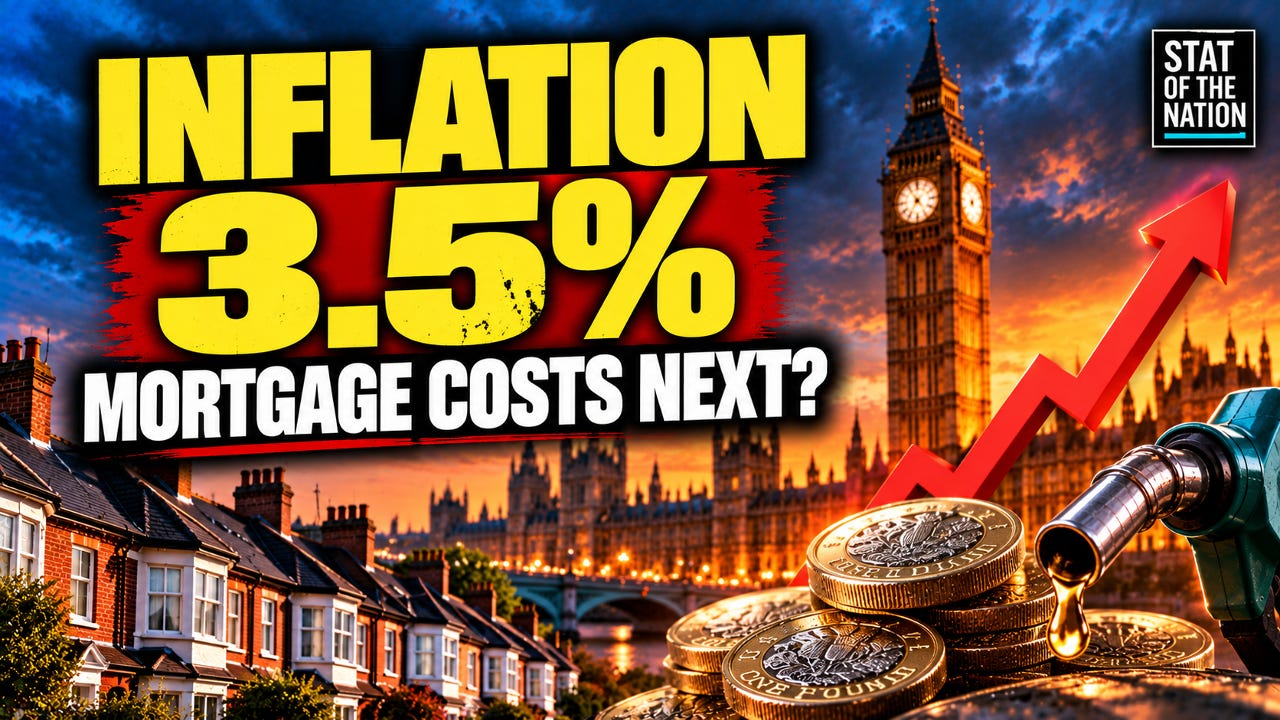
Britain’s inflation problem is moving in the wrong direction again.
The latest Office for National Statistics figures, published today, show annual inflation rising to 3.5% in September, up from 3.1% in August and 2.6% in June.
That’s the highest rate since October 2025, moving inflation further away from the Bank of England’s 2% target.
The biggest driver has been soaring fuel prices, largely reflecting disruption to global energy markets.
But the consequences could stretch far beyond the petrol station, potentially affecting mortgages, government borrowing and public spending.
Inflation Is Rising Again
The headline Consumer Prices Index (CPI) rose by 3.5% over the year to September, while the broader CPIH measure, which includes owner-occupiers’ housing costs, increased to 3.6%.
Underlying inflationary pressures have also strengthened:
Core inflation: 2.8%, up from 2.6%.
Goods inflation: 3.2%, up from 2.7%.
Services inflation: 3.7%, up from 3.4%.
Goods inflation is now at its highest since September 2023.
The Bank of England will be watching closely for signs that higher energy prices are spreading into wider prices and wages.
Where Are Prices Rising Fastest?
The latest ONS figures reveal some significant differences across household spending.
Transport costs are up 6.6%, communications 5.8%, housing and household services 5.3%, and education 5.0%.
Housing remains a particular pressure, with owner-occupiers’ housing costs rising 4.0% over the year.
There is, however, some better news.
Food inflation remains at just 1.3%, its lowest annual rate since September 2021, while inflation in restaurants and hotels eased from 4.1% to 3.8%.
But those improvements haven’t been enough to offset renewed inflation elsewhere.
Fuel Prices Have Risen Nearly 30%
Transport was the largest contributor to September’s increase in the annual inflation rate, driven particularly by motor fuels.
According to the ONS, petrol averaged 169.5p per litre in September, while diesel reached 192.5p.
Motor fuel prices were 29.8% higher than a year earlier.
And September’s figures are already dated.
The latest reported forecourt averages from Fuel Finder UK put diesel at approximately 198.8p per litre on 21 October.
At that price, around 86p of every litre is fuel duty and VAT.
As fuel prices rise, the amount of VAT charged per litre also increases, even though the tax rate itself remains unchanged.
Global energy disruption explains much of the surge in pump prices, but domestic fuel taxation remains a government policy decision.
Could Mortgage Costs Rise Further?
Perhaps the most worrying consequence of persistently higher inflation is the potential impact on borrowing costs.
The Bank of England’s main interest rate currently stands at 3.75%.
But mortgage rates have already increased.
In its September Monetary Policy Committee minutes, the Bank reported that quoted two-year fixed mortgage rates were approximately 0.95 percentage points higher than before the Middle East conflict.
That’s despite Bank Rate remaining unchanged.
Financial markets have already adjusted to expectations of higher interest rates, pushing up the cost of new mortgage deals.
The Bank now faces a difficult balancing act.
Increasing interest rates cannot directly resolve global energy supply disruptions. But allowing inflation to become embedded in wider prices and wages could create longer-term problems.
The last thing households need, when already facing higher fuel, energy and everyday living costs, is another increase in mortgage repayments.
Inflation Also Puts Pressure on Government Finances
Higher inflation doesn’t just affect households. It can also put further pressure on the public finances.
When investors expect inflation and interest rates to remain higher, they may demand higher yields on government bonds, known as gilts.
That can increase the cost of new government borrowing and refinancing existing debt.
The Government is also exposed through inflation-linked debt.
According to the Treasury’s Debt Management Report, the UK had approximately £688.5 billion of index-linked government debt at the end of December 2025.
Payments on these gilts are linked to the Retail Prices Index (RPI), which reached 3.9% in September.
Higher RPI inflation increases the costs associated with that debt.
Then there’s benefit expenditure.
September’s CPI figure is used to determine increases in many working-age benefits the following April, subject to the relevant uprating rules.
With CPI at 3.5%, this creates further inflation-linked spending commitments for 2027–28, helping protect recipients against rising prices but adding to pressures on public expenditure.
Higher inflation can therefore affect government finances through both debt costs and spending.
The Bottom Line
The latest figures show Britain’s inflation problem is far from resolved.
Headline inflation is rising, fuel prices have surged, and underlying price pressures are strengthening.
There are some encouraging signs, particularly in food inflation, but the wider economic risks are considerable.
Higher inflation could mean higher mortgage costs, more expensive government borrowing and increased inflation-linked public spending.
Much of the latest energy shock originates overseas, beyond Britain’s direct control.
But domestic economic policy will play an important role in determining how households and businesses cope.
With the Bank of England facing another difficult interest-rate decision, the last thing families need is a further squeeze on their finances.
How much more pressure can households and the public finances absorb?
Thanks for reading Stat of the Nation. I break down the statistics behind the headlines, cutting through the political spin to explain what’s really happening across Britain.
If you value independent, evidence-based analysis, please share this article and subscribe for more statistics behind the headlines.
✍️ Jamie Jenkins
Stats Jamie | Stats, Facts & Opinions