

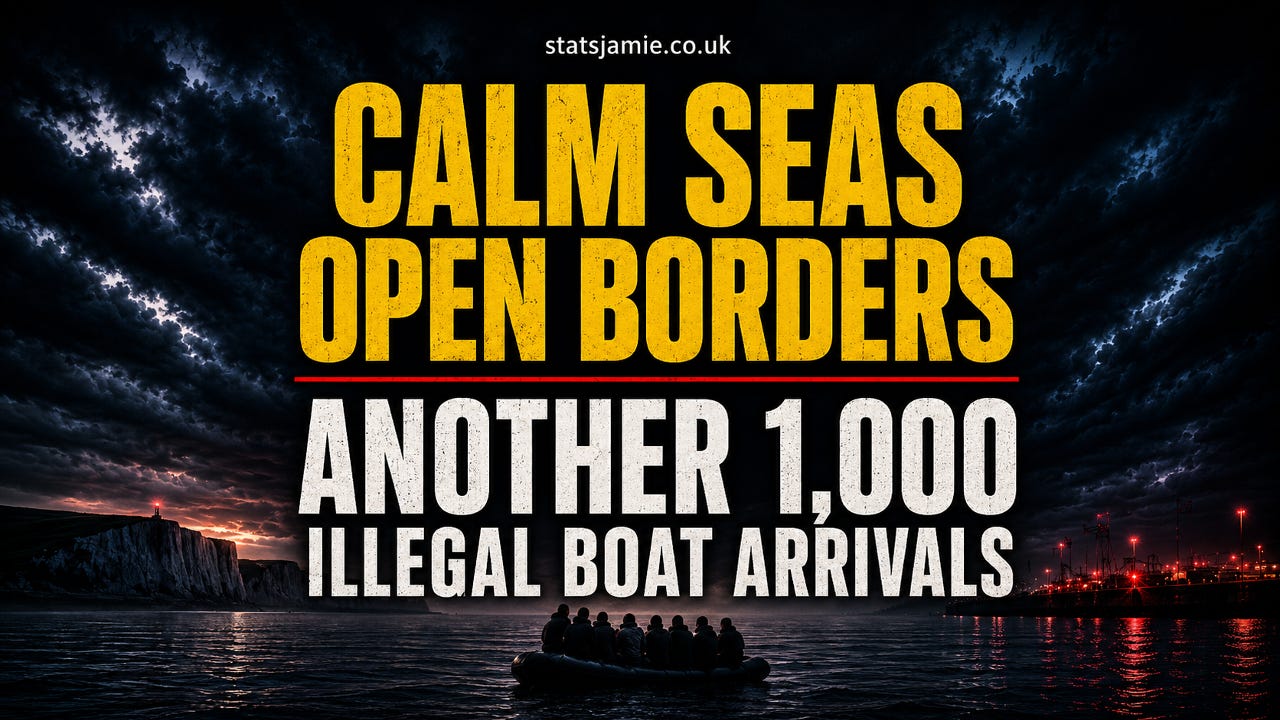
Warm weather, calm seas, and a bank holiday weekend. As night follows day, the small boats return.
From Friday to Monday, official figures recorded 989 people crossing the Channel in 14 boats: 394 on Friday, 287 on Saturday, 231 on Sunday and 77 on Monday. With further arrivals on Tuesday, the five-day total has now passed 1,000 people.
The published data describes these as people attempting to cross the Channel in small boats “without permission to enter the UK.”
That means more than 1,000 people have arrived through an illegal route in just five days. Once they arrive, the cost does not disappear. It moves onto the British taxpayer through Border Force, processing, accommodation, legal appeals, enforcement, removals and the wider asylum system.
The boats launch. Britain receives. The taxpayer pays.
And the question the public are entitled to ask is simple: who exactly has just entered the country?
The Calm Weather Warning Nobody Wants To Give
The latest surge should surprise nobody. Official statistics note that small boat numbers fluctuate daily, often because of weather conditions, with warmer summer months typically seeing higher numbers due to more favourable crossing conditions.
So let’s not pretend this is unforeseeable. The weather improves, the Channel calms, the smugglers move, and Britain is left to process the consequences afterwards.
We are used to public warnings when the weather turns hot. The public are told to take care, check on vulnerable people and prepare for the risks that come with high temperatures. But there is another predictable consequence of calm, settled weather that does not get treated with the same urgency: the small boats start moving.
When the Channel calms, the smugglers know it. The authorities know it. Ministers know it. And the British public knows what comes next.
If the state can warn people about the risks of hot weather, it can also be honest about the risks created when large numbers arrive through an illegal route, often with uncertain documentation, and the public is simply asked to trust that everything is under control.
Control is not a ministerial statement, a press release, or another meeting with France. Control means stopping the route. Right now, when the weather turns, the route reopens.
Who Exactly Has Entered Britain?
The issue is not whether every person on those boats is dangerous. Clearly, they are not. Some may have genuine asylum claims. Some may be fleeing awful circumstances. Some may eventually be judged to have a legal right to remain.
But that is not the same as saying the route is safe, controlled or acceptable.
The public is entitled to ask basic questions. Who are these people? Where have they come from? What documentation do they have? What checks have been carried out? And can the authorities say with confidence that every person arriving has been properly identified and assessed?
That question becomes even more important when people arrive through an illegal route, often after passing through multiple countries, and sometimes with little or no reliable documentation. If someone arrives without papers, or with identity details that cannot be quickly verified, how can the state confidently say who has entered the country?
This is not a minor administrative issue. Identity is the foundation of border control. Without reliable identity, everything else becomes weaker: asylum decisions, criminal checks, security screening, removals and public protection.
That matters because the small boat route is overwhelmingly made up of adult men. Official statistics show that since January 2018, 75% of small boat arrivals have been adult males aged 18 and over.
That does not make every adult male a criminal. But it does make proper identity checks, security screening and enforcement absolutely essential.
This is where the public protection question becomes unavoidable. The government says its first duty is to keep citizens safe and the country secure. So judge it by that test.
If just a handful of people among this latest thousand go on to commit serious crimes in Britain, then the state has failed again in its most basic duty: protecting the border and protecting the British public.
You do not need every arrival to be a threat for the system to become a threat. You only need the wrong people to get through.
The Bigger Picture: This Has Become Normalised
This bank holiday surge is not happening in isolation. It sits on top of years of failure in which a once smaller route has become a permanent feature of Britain’s border crisis.
The published small boats time series now shows 201,175 detected arrivals since records began in 2018, up to 25 May 2026. What began as a relatively small route has become a major, recurring route into Britain.
That is the wider context. This is no longer a one-off emergency response problem. It is a route that activates when the weather allows, that smugglers understand, that ministers condemn, and that the state still fails to stop.
After the outrage, after the new laws, after the slogans, after the promises to smash the gangs, the boats still come.
That is not border control. It is a managed failure.
More Money To France, Same Result
And what is the government’s answer? More money to France.
In April, the UK and France announced a new agreement to reduce illegal crossings. The deal was presented as a strengthening of operations in northern France, with more personnel, more technology and more intelligence resources. Personnel deployed under the partnership are set to rise by 53%, from 907 in the 2023 to 2026 cycle to 1,392 in the 2026 to 2029 cycle.
The funding is substantial. The House of Commons Library says the UK has agreed to provide £662 million to France between 2026/27 and 2028/29 under the new three-year funding agreement, with £501 million to strengthen existing controls in northern France and £161 million available for new tactics.
So the public hears the same story again: more cooperation, more enforcement, more technology and more funding. But then the bank holiday arrives, the weather improves, and another thousand people come across the Channel.
At some point, the public are entitled to judge these deals by outcomes, not announcements. If the result is still boats on the water and arrivals in Britain, then what exactly has changed?
Britain keeps sending money to France. The boats keep coming to Britain. And the British taxpayer keeps picking up the bill.
Conclusion: Remove The Incentive, Or The Boats Will Keep Coming
The small boat crisis is not just a migration story. It is a public protection story.
Britain now has a route into the country that activates whenever the weather allows. Hundreds can arrive over a long weekend. The route is dominated by adult men. Many arrive without prior permission. And the public is asked to trust that the state has everything under control.
But control means knowing who is entering the country. It means stopping those with no right to be here. It means removing those who pose a risk. It means protecting the border and protecting the British public.
The deeper problem is incentive. If people know that reaching Britain means being brought ashore, housed, processed, legally represented, and potentially remaining here for years while the system works through their case, then the route still has a reward attached to it.
That reward is what has to end.
The only serious deterrent is to make clear that arriving illegally by small boat does not get you into the British asylum system, British hotels, or years of taxpayer-funded limbo. It gets you transferred elsewhere for processing, so the incentive to land in Britain disappears.
That is the test. Not slogans. Not another cheque to France. Not another announcement about smashing the gangs.
If another thousand people can arrive in five days, through an illegal route, at the cost of the taxpayer, the question is not whether the government sounds tough. The question is whether the border is secure at all.
And on the evidence of this bank holiday weekend, the border is not secure.
✍️ Jamie Jenkins
Stats Jamie | Stats, Facts & Opinions
📢 Call to Action
If this helped cut through the noise, share it and subscribe free by entering your email in the box below and get the stats before the spin, straight to your inbox (no algorithms).
📚 If you found this useful, you might also want to read:

📲 Follow me here for more daily updates:
Dear Makerfield
Read this and weep!
Vote Reform
That's the Arrivals now where are the Departures. Another great piece Jamie !