

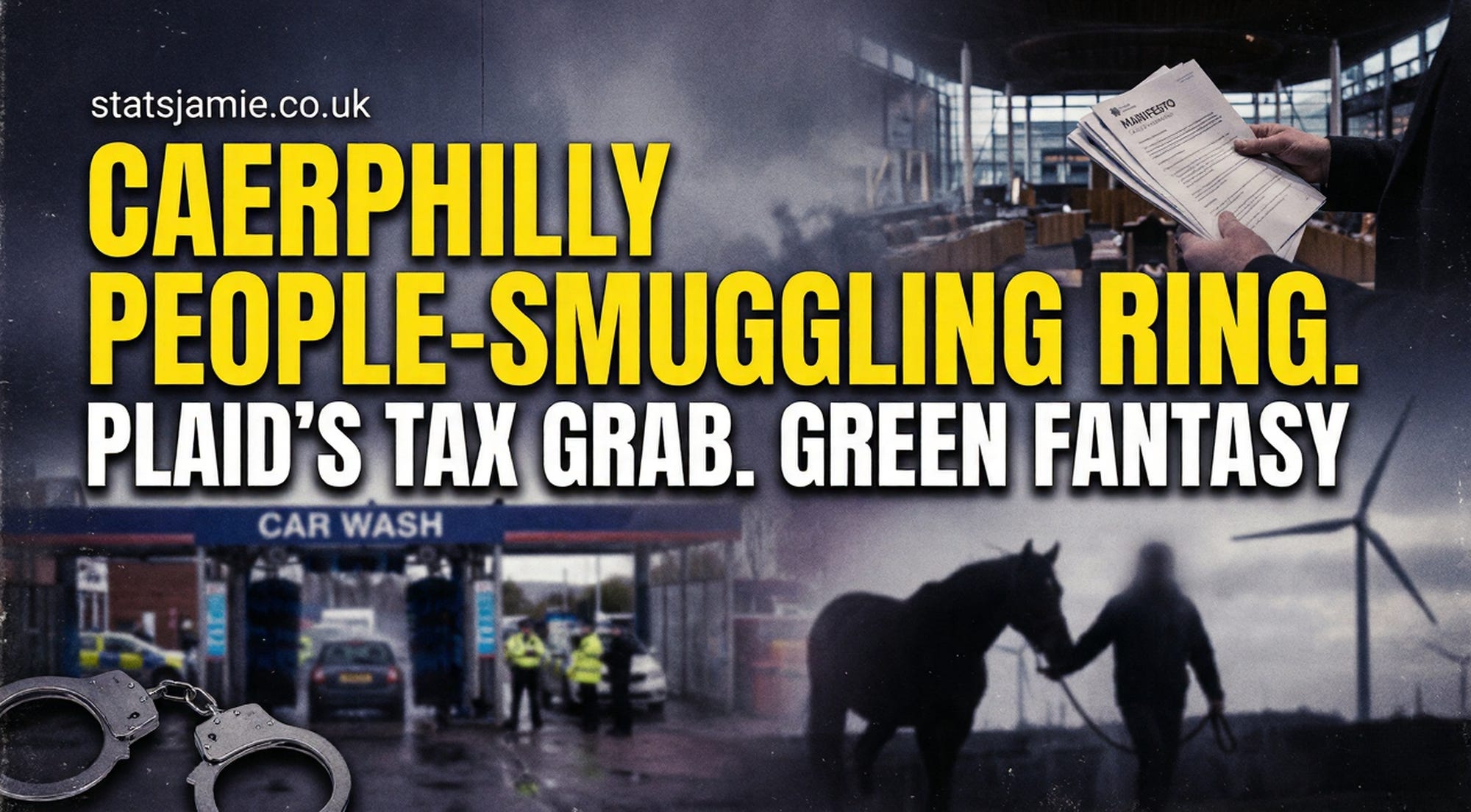
This week offered a pretty clear snapshot of modern politics in Britain and Wales.
On one side, organised immigration crime operating in Welsh communities. On the other hand, parties demanding more powers, more spending and more control, while offering very little evidence that they can use the powers they already have well. Different stories, same pattern.
🚨 The Caerphilly Case Exposes A Bigger Failure
The most striking story of the week was not a manifesto launch. It was the National Crime Agency confirming that a people-smuggling operation was being masterminded from a car wash in Caerphilly. Two men were jailed for 19 years each, and the NCA says it believes they smuggled more than 400 people in just six months.
That matters because it cuts across one of the biggest issues in Britain today. Illegal immigration is not just about boats in the Channel or arguments in Westminster. It is also about organised criminal networks operating on the ground, including in Welsh communities.
Once people enter the country illegally, they can still go on to commit serious offences, and the public ends up paying again through policing, prosecution, prison and wider enforcement costs. In this case, the NCA investigation was supported by Gwent Police, and the public now picks up the bill for the consequences.
We are often told immigration is not devolved, as if that settles the matter in Wales. Formally, border control is not devolved. But the consequences of illegal immigration and organised criminality do not sit neatly in constitutional boxes. They land in local communities, on local services, and ultimately on the public purse.
That is why this story matters. It is not just about one case in Caerphilly. It is about a wider failure of control, enforcement and political seriousness.
🏴 Plaid Cymru — More Power, More Tax, Less Credibility
With less than a month to go until the Senedd election, Plaid Cymru launched its manifesto this week. Like many of the parties, it is full of promises. But, again, like many of the parties, there is far less detail on how all of it would actually be paid for.
Plaid likes to present itself as the fresh alternative in Welsh politics. But on the big questions, its instincts are familiar: more powers, more intervention and more tax.
Wales is already taxed enough under Westminster. But Plaid’s answer is not to lighten the burden — it is to demand more devolved powers so Cardiff Bay can levy more taxes of its own. The manifesto backs made-in-Wales income tax bands, a Vacant Land Tax and an increase in the Senedd’s total capital debt limit from £1 billion to £3 billion. It is the same socialist instinct as ever: when the model fails, take more, spend more, and promise that next time it will work.
That is hard to take seriously when health outcomes and education outcomes in Wales are worse than in England. Plaid’s own manifesto says around 1 in 5 people in Wales is on an NHS waiting list, with more than 5,000 waiting more than two years for treatment, and that Wales recorded its lowest ever PISA scores in 2022. After more than two decades of devolution, that should be the starting point for humility. Instead, Plaid’s answer is to ask for more powers, more borrowing and more room to do even more of the same.
The contradiction runs deeper than that. Plaid wants Wales to move towards leaving one political and economic union — the United Kingdom — while also pushing to move closer to another in Europe through the single market and customs union. The manifesto says the UK should urgently seek to rejoin both. That is not realism. It is a constitutional obsession dressed up as a strategy.
Its stance on immigration reflects a similar instinct. The manifesto says Plaid does not support open borders or uncontrolled migration, but backs a Wales-specific visa and shortage occupation list as a first step towards devolving immigration powers. It also opposes restrictions on student visas and wants a joined-up strategy to support migrants and sanctuary seekers with no recourse to public funds.
That all points in one direction: a softer, more accommodating instinct.
When a party signals that it wants a more welcoming approach without giving equal weight to enforcement and control, it risks sending the wrong message. Border policy must begin with public safety. If even one person who should not have been in this country goes on to attack a woman or a child — something we have seen far too often — that is one too many.
There is also a political reality here that cannot be ignored. For many of the key years of devolution, Plaid has supported Labour, whether through formal deals or informal partnerships. Its co-operation agreement with Welsh Labour ran until May 2024.
That is part of the credibility gap at the heart of Welsh politics. Too many of the people asking for more power have done too little with the power they already have. And if you are honest about the standard of talent on display, you do have to wonder how many would command anything like the same level of responsibility or reward in a competitive private-sector environment. Very few, I suspect.
💷 The New Tax Year — The State Expands Again
The new tax year brought one of the biggest policy changes of the week: the scrapping of the two-child limit. The government says the change will put 450,000 children on a pathway out of poverty in the final year of this Parliament, and that up to 1.5 million children across Great Britain could be helped by the change.
That is the compassionate case, and it is easy to see why it resonates. But there is a wider point that should not be ignored.
Britain is already living with one of the highest tax burdens in decades, and yet the response to weak living standards is still to expand redistribution rather than tackle the underlying causes. Instead of building a country where families keep more of what they earn, the system increasingly works by taking more from working households and then handing more of it back through the state.
That tells you a lot about the direction of travel. Britain is becoming a country where government failure is answered not with reform, but with a bigger bill.
🐎 The Greens — From Anti-Car To Anti-Horse
The Green Party also provided one of the more telling stories around Grand National weekend, with renewed attention on comments from Zack Polanski calling for animals to be removed from sport. As reported, Polanski wrote on X in 2024: “Let’s go further and remove all animals involved in sport.” He has also backed banning equestrian events from the Olympics.
That matters because this is not some tiny fringe issue. Horse racing is a major industry worth around £4 billion, tied to jobs, events and local economies.
It also brought a sharp response from one of racing’s best-known figures. Trainer Nicky Henderson invited Polanski to visit his yard and see the reality for himself. As Henderson put it, “It’s a five-star hotel for horses. These wonderful animals are bred to race.”
That line gets to the heart of the debate. For many people involved in the sport, this is not cruelty dressed up as tradition. It is a long-established part of British life built around the care, training and performance of elite animals.
What stands out is the wider pattern. First, the focus was on reducing car use, and now it extends into traditional leisure and sport. For a party that presents itself as tolerant and progressive, there is an increasing tendency to challenge and restrict ordinary choices and long-standing traditions that do not align with its worldview.
🌱 The Green Agenda In Wales — Full Of Fantasy, Still Worrying
The Welsh Green Party launched its manifesto this week, with the cost-of-living crisis presented as a top priority. The pitch included a long list of commitments and support measures.
Like many of the parties, it is full of promises. But the familiar problem remains: there is far less clarity on how any of it would really be paid for.
That matters because, however unrealistic some of these policies may sound, they are not politically harmless. The Greens are no longer just a fringe protest outfit shouting from the sidelines. Their ideas could still influence the direction of the next Welsh government if the numbers line up.
The problem is that much of this agenda appears disconnected from how people actually live, particularly in Wales. Large parts of the country remain rural, car-dependent, and less able to absorb policies designed around urban assumptions and activist preferences.
That is why this manifesto should be taken seriously, even if much of it reads like fantasy. It is full of expensive promises, light on funding detail, and built around policies that would push Wales further toward a bigger, more interventionist state.
🎯 Conclusion
Put together, this week’s stories paint a consistent picture. Plaid Cymru continues to lean toward more tax powers, more borrowing and more constitutional focus, rather than confronting the outcomes of the current model. Westminster continues to expand the welfare state while leaving deeper economic challenges unresolved. And the Greens are becoming more confident in pushing policies that extend into how people live their daily lives.
At the same time, serious issues such as organised immigration crime are too often handled cautiously or avoided altogether, particularly when politicians can hide behind arguments about devolved powers rather than show real leadership.
That is why these stories matter when viewed together. They reflect a broader political instinct to expand the role of the state while struggling to deliver improvements where they are most needed.
Because increasingly, the direction of travel feels clear: a larger state, greater intervention, and growing pressure on the people who fund it.
✍️ Jamie Jenkins
Stats Jamie | Stats, Facts & Opinions
📢 Call to Action
If this helped cut through the noise, share it and subscribe for free by entering your email in the box below and get the stats before the spin, straight to your inbox (no algorithms).
📚 If you found this useful, you might also want to read:
Rather Than Blame Brexit, Rachel Reeves Should Look In The Mirror At The UK’s Lack Of Growth

Yesterday, the Chancellor unveiled a new set of “key principles” for UK-EU alignment, presenting it as part of a broader growth pitch for the country. The government says this is about reducing friction for business, backing AI and innovation, and “unlocking growth in every region.”
📲 Follow me here for more daily updates:
Thanks Jamie. It's staggering how stupid the electorate must be to elect these comic book characters into office. I cry for Wales and for the UK 😢!