

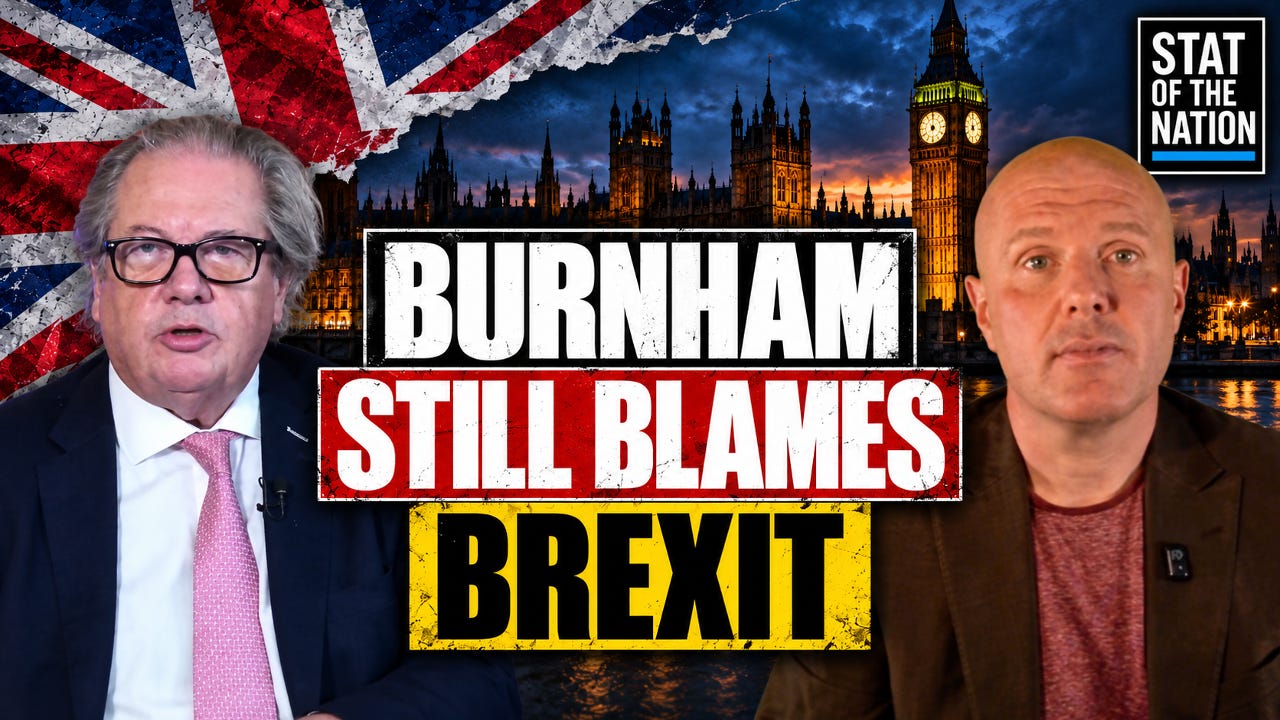
Andy Burnham is back in Westminster — and Brexit is once again part of the explanation being offered for Britain’s weak economic performance. In my latest discussion with Mike Graham on the The Mike Graham Show, we looked at Burnham’s argument, what the growth data actually shows, and some of the deeper problems holding Britain back.
Burnham Is Still Blaming Brexit
Burnham argues that Brexit has contributed to a decade of poor economic growth.
But treating Brexit as a defining explanation for Britain’s weak performance misses a much bigger picture.
Since the referendum, the UK economy has grown more than Germany and Italy and broadly in line with France. Spain has done considerably better.
What Is Really Holding Britain Back?
Britain should be doing much better.
The question is not whether we have beaten Germany over the past decade. It is why an economy with Britain’s strengths has struggled to generate stronger, sustained growth.
One issue I raised with Mike was energy.
Cheap, reliable energy matters enormously for economic growth. It affects manufacturing, hospitality, retail, transport, data centres and ultimately the prices households pay.
If British businesses face higher costs than their international competitors, it becomes harder to invest, expand and create jobs.
Taxation, productivity, regulation and business investment all matter too.
Blaming Brexit is easy. Building a genuinely competitive economy is much harder.
Britain’s Borrowing Costs
We also discussed what has been happening in the bond markets.
Public sector debt is approaching £3 trillion, while more than £100 billion a year is being spent servicing the debt.
Some of the recent rise in gilt yields reflects global pressures, but Britain’s borrowing costs remain particularly high.
Continually adding to the debt pile makes that increasingly expensive.
Ultimately, governments only have a few ways to improve the position: cut spending, raise taxes or generate stronger economic growth.
And continually raising taxes risks making that third objective harder.
Has Devolution Delivered?
Mike and I also discussed Burnham’s calls for greater devolution.
The principle sounds attractive: decisions should be made closer to the people they affect.
But after more than 25 years of devolution in Wales, the question should be straightforward:
Has it actually produced better outcomes?
More layers of government mean more politicians, more staff and more administration.
The justification has to be better public services or genuinely better policymaking.
Healthcare should have been one of the great tests of devolution — different parts of Britain trying different approaches and learning from what works.
Instead, Wales gives us plenty of reasons to question whether devolving more power automatically means better government.
The Bigger Picture
Britain absolutely has a growth problem.
But the causes run much deeper than one referendum.
Energy costs, tax, spending, productivity, investment and the size of the state all matter.
Politicians can keep looking back to 2016.
Or they can explain what they are going to do to make Britain more competitive today.
✍️ Jamie Jenkins
Stats Jamie | Stats, Facts & Opinions
If you found this analysis useful, please share it and subscribe for more.
📲 Follow me here for more daily updates: