

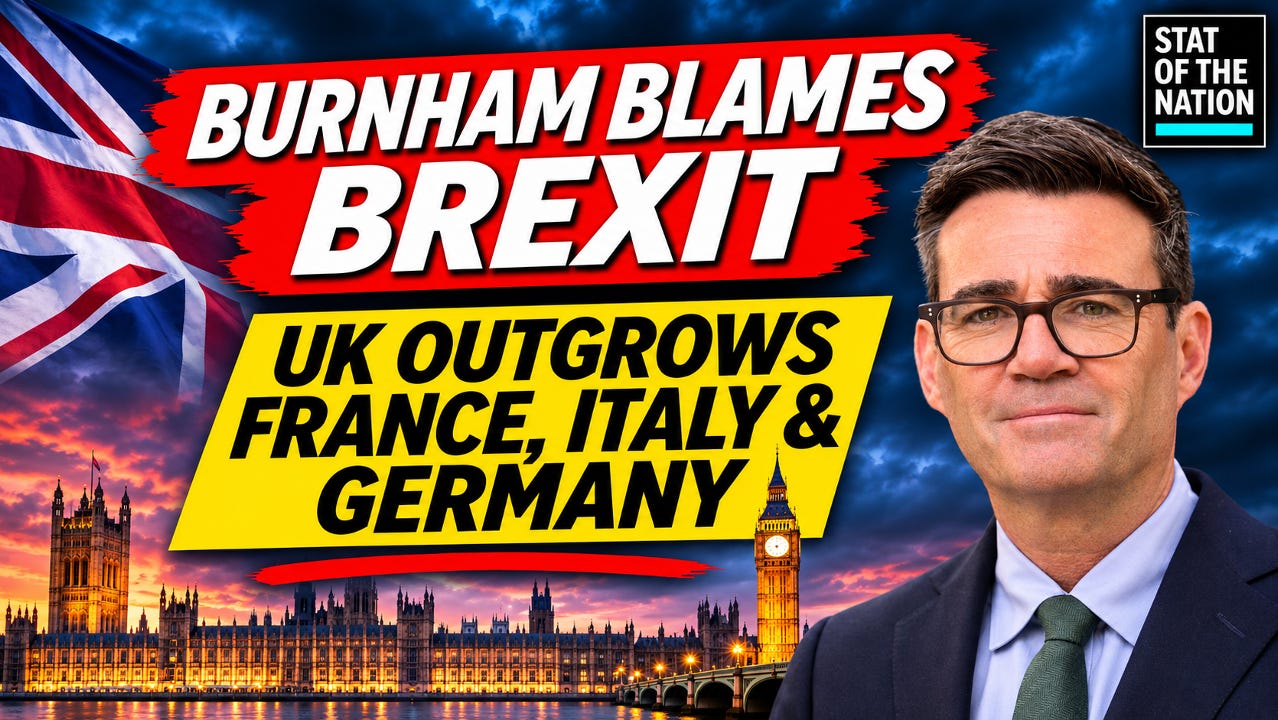
Britain’s economy has grown by 14.7% since the Brexit referendum. Germany’s has grown by 8.0%, France’s by 12.6% and Italy’s by 12.2%.
Now Prime Minister Andy Burnham says Britain has “lost more than we’ve gained” from leaving the European Union.
I know. Here I am talking about Brexit again.
But with fresh GDP figures published this week, another UK–EU summit approaching and renewed arguments about food prices, it’s worth examining what the statistics actually tell us.
Britain’s GDP Growth: The Latest Figures
On 12 November, the Office for National Statistics published its latest GDP figures.
The British economy grew by 0.7% in the third quarter of 2026, following growth of 0.5% in the previous quarter.
So how does Britain compare with Europe’s major economies since the referendum?
Using the latest inflation-adjusted GDP figures from Q2 2016 to Q3 2026, Spain leads the five-country comparison with growth of 22.2%, followed by the UK at 14.7%, France at 12.6%, Italy at 12.2% and Germany at just 8.0%.
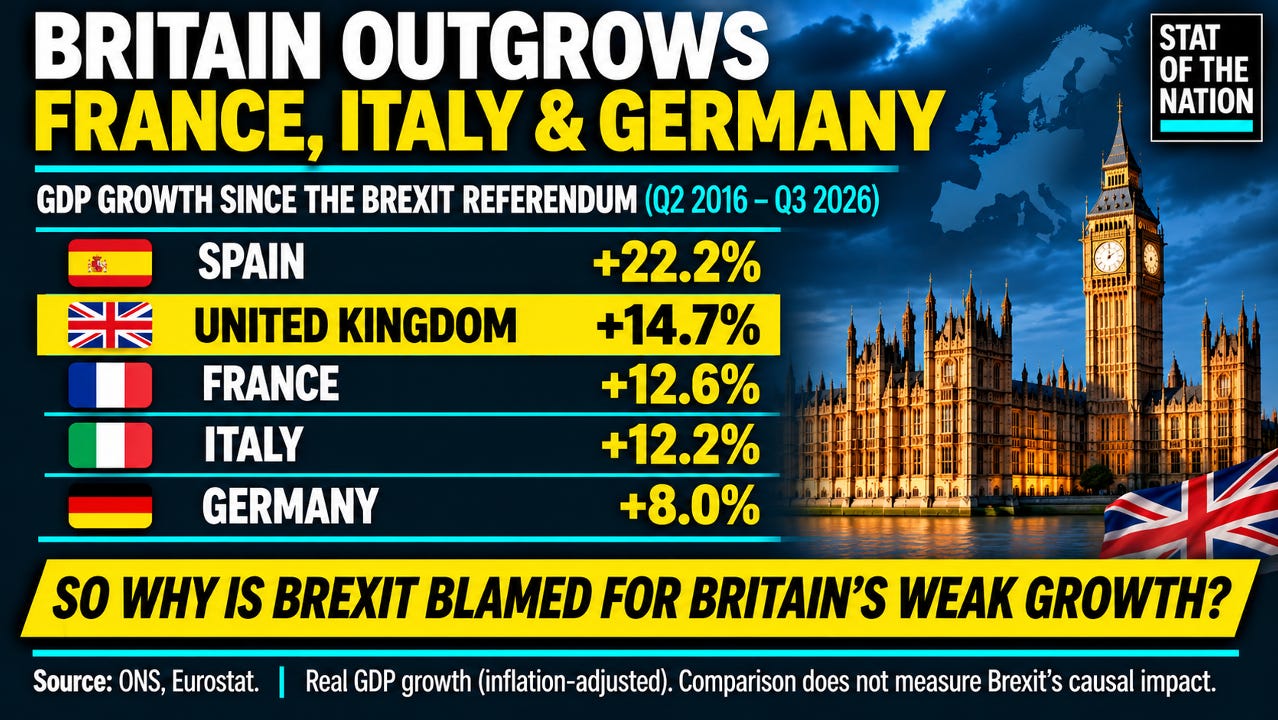
I’ve used the referendum quarter as the starting point because the result could begin influencing investment, business confidence and economic decisions long before Britain formally left the EU.
Now, some economists attempt to estimate how much larger Britain’s economy might have been had we remained in the European Union.
Such models can offer useful insights, but they depend on assumptions about an alternative economic path that cannot be directly observed. Their conclusions are estimates, not measured outcomes.
That’s why I prefer to start with what we can actually measure.
Britain has recorded stronger total economic growth than France, Italy and Germany since the referendum.
That doesn’t establish whether Brexit reduced Britain’s potential growth. Both things can be true.
But it does highlight something frequently overlooked in the political debate.
Britain’s disappointing economic performance is hardly unique.
Germany, often described as Europe’s industrial powerhouse, has experienced particularly weak growth. France and Italy have also struggled despite remaining members of the EU.
These economies have all faced major challenges, including the pandemic, soaring energy costs and weak productivity growth.
Yet whenever Britain experiences disappointing growth, Brexit is frequently presented as the central explanation.
Perhaps we should spend more time examining the policies holding back Britain’s economy rather than treating the referendum as the answer to every economic question.
Food Prices Have Soared — Across Europe
Another familiar Brexit argument concerns food prices.
Social media is full of commentators attributing Britain’s soaring supermarket bills to leaving the European Union.
And let’s be clear: food prices in Britain are ridiculously high compared with what households were paying just a few years ago.
According to the latest ONS figures, food and non-alcoholic drink prices were approximately 38% higher in September 2026 than in December 2019.
A basket costing £100 at the end of 2019 would now cost around £138.
That’s an enormous increase for families to absorb.
But Britain is hardly alone.
On a like-for-like annual basis, comparing average prices in 2019 with 2025, food prices increased by approximately 40% in Germany and 38% in Spain, compared with 37% in Britain.
Both Germany and Spain remained inside the European Union throughout. The comparisons use closely related consumer price measures, although there are some methodological differences.
So what has been driving these increases?
Across Europe, food producers and retailers have faced an enormous cost shock.
Energy prices surged, particularly following Russia’s invasion of Ukraine. Fertiliser production became more expensive, transport and refrigeration costs increased, and global supply chains experienced widespread disruption.
Britain also faces significant domestic energy costs, which affect everything from farming and food manufacturing to distribution and supermarket operations.
Brexit-related trading barriers have added costs to some food imports, but they are only one part of a much wider inflationary picture.
Food prices have risen dramatically in Britain. But they’ve also soared in countries that never left the EU.
That international context matters when trying to understand why households are paying so much more for their weekly shopping.
Burnham’s Brexit Promise — And Labour’s Leave-Voting Constituencies
Burnham’s renewed enthusiasm for discussing Brussels sits awkwardly with what he told voters earlier this year.
Back in May, while campaigning for the Makerfield by-election, he argued that Britain should stop reopening the arguments surrounding Brexit.
He said he wasn’t proposing that Britain consider rejoining the EU and stressed the importance of respecting the referendum result.
That was particularly relevant in Makerfield, where estimates suggest 65.8% of voters backed Leave in 2016.
And there’s a wider political contradiction.
My analysis of the current Cabinet suggests that 17 of the 22 MPs who are full Cabinet members represent constituencies estimated to have voted Leave in 2016.
That’s approximately 77%.
These are estimates of how constituencies voted a decade ago, rather than official constituency referendum results or a measure of today’s public opinion.
Nevertheless, they provide useful context.
Fast-forward six months, and Burnham is Prime Minister, arguing that Brexit has caused significant economic damage and discussing options for Britain’s longer-term relationship with the EU.
He has even acknowledged that a future Labour manifesto could contain a commitment to another referendum.
That’s quite a shift in emphasis since his Makerfield campaign.
It’s also worth remembering what Labour promised voters at the 2024 general election.
Its manifesto explicitly ruled out returning to the single market, customs union or freedom of movement, while promising closer trade cooperation, including an agreement on food and agricultural standards.
The forthcoming negotiations on food trade are consistent with that commitment.
But any proposal to go substantially further deserves much greater scrutiny.
With another UK–EU summit scheduled for 20 November, voters should know what economic benefits are expected, what obligations Britain might accept and which decisions would remain under Westminster’s control.
If Burnham wants to fundamentally change Britain’s relationship with the European Union, he should put the proposals in a manifesto and seek a mandate at a general election.
He has already said that any future attempt to rejoin the EU should be put to voters. The important thing is that those commitments are honoured.
Britain’s Economy Needs More Than Another Brexit Argument
More than a decade after the referendum, Britain’s political leaders are still arguing over the decision to leave.
Meanwhile, the country faces serious economic challenges.
We need stronger productivity, greater private investment, affordable energy and policies that make Britain a more competitive place to do business.
The latest GDP figures show that Britain has outgrown several major EU economies since the referendum. The food-price data demonstrates that the inflation shock has affected households across Europe.
These are important facts that deserve a place in the debate.
If closer cooperation with Brussels can deliver measurable benefits, the government should explain them. But changes to Britain’s relationship with Europe should be judged on their economic merits, regulatory consequences and democratic legitimacy.
After a decade of Brexit arguments, the priority should be growth and living standards.
Because blaming Brexit won’t, by itself, make Britain more prosperous.
✍️ Thanks for reading Stat of the Nation. If you find my analysis useful, please share or subscribe to support my work.
✍️ Jamie Jenkins
Stats Jamie | Stats, Facts & Opinions
📲 Follow me here for more daily updates:
The argument that the UK economy would have grown even more if we had remained in the EU is one thing but another point is that had our politicians fully grasped the opportunities and benefits of Brexit immediately it may also have grown more. All the parties acted as if the referendum hadn't happened. We were let down.
Brexit for me was always about sovereignty. I don't know enough to argue about economy but I never believed the scare stories, do you remember? Sterling would collapse, thousands of businesses would fold, there would be mass unemployment. None of that happened. There's a trade off - the economy against the freedom to choose the people who actually make the decisions about how our country is run. There was never a balanced argument, especially from the remainers. Joining the EU brings with it a lot of baggage.
I have read that the financial markets and services in London have been doing pretty well since Brexit but I don't know if that's true.
I still do not understand the obsession the political/media class have about the European Union. Politicians generally want as much power as they can get so why return to a politcal union that strips that power away to unelected officials? Do all British politicians think the EU gravy train is the one to be on? They all want to replace Ursula? Or they think the positions at NATO or the UN won't be offered without the EU badge?
The EU appears to be just as corrupt as it was 10 years ago - has it balanced its finances yet? The crazy obsession with funding the oligarchs of Ukraine seems to be madness. The inability to control illegal migration is no better than here - I see a load arrived in the Canary Islands recently.
If our political class actually wanted to improve things here they would be looking at drilling for oil/gas, building new power stations, reducing taxes on everything, cutting benefits to encourage employment, reducing/stopping overseas aid to countries which don't need it (India? China?) and countries whose people dislike us enough to try and blow us up. They would be looking at reducing the costs of running a business, reducing the cost of buying a house, reducing the red tape and taxation for farms, cancelling all Net Zero contracts and removing all turbines and solar panels. They would be cutting funding to the NHS and making hospitals independently funded whilst stopping revolving door appointments for health executives into pharma executives.
There's much more I could write but there's no real point is there because none of this will happen. Andy Burnham will ignore the citizens of this country and do what his political friends want. Which will simply make bad situations much worse.