

Britain’s economy is growing at its fastest quarterly pace in more than two years. Despite rising energy prices, inflation and global uncertainty, economic activity has proved remarkably resilient. That’s welcome news, but dig beneath the headline figures and a more complicated picture emerges.
Economic output per person has increased by 2.7% over the past two years, yet estimated real household disposable income per person has barely changed. Meanwhile, technology is powering ahead, private housebuilding is shrinking, and pubs and restaurants are experiencing a sustained decline.
Britain’s economy is growing. But how much of that growth is actually making people better off?
Britain’s Economy Is Growing — And That’s Good News
The latest Office for National Statistics figures, published on Thursday, show the UK economy grew by 0.7% between July and September 2026, following growth of 0.5% in the previous quarter. The economy is now 1.9% bigger than a year ago.
Importantly, GDP per person is also increasing, meaning the expansion cannot simply be explained by population growth. The biggest driver has been Britain’s services sector, which expanded by 0.9% during the quarter.
This includes everything from banking, accounting and computer programming to retail, hospitality and professional services. But there is an important distinction: businesses providing services to other businesses are performing considerably better than those serving consumers directly.
While the overall picture is encouraging, some industries are enjoying much stronger growth than others.
The Economy Is Growing — But Household Incomes Are Standing Still
One of the most important findings from Thursday’s economic news concerns the difference between economic growth and household living standards.
Analysis by the Resolution Foundation shows that GDP per person has increased by 2.7% over the past two years, since the third quarter of 2024. Yet real household disposable income per person has been virtually unchanged, falling by an estimated 0.04% over the same period.
The latest income figure partly relies on official forecasts rather than published household income data, but the contrast is important. GDP measures what the economy produces, while real household disposable income measures the money households have available after direct taxes and benefits, adjusted for inflation.
Ultimately, most people judge the economy through their own experiences. Are wages keeping pace with prices? How much does the mortgage or rent cost? What are families paying for energy, petrol and groceries?
Those questions are becoming increasingly relevant. The Bank of England raised interest rates to 4% in November, as higher global energy costs pushed inflation upwards. The Bank expects inflation to rise further over the coming months.
As I explained in last week’s article on energy prices and interest rates, higher interest rates cannot directly bring down global energy prices. But they can push up mortgage bills for families whose real incomes have already stalled.

The Bank argues that higher rates are necessary to prevent rising energy costs feeding through into other prices and wages. That’s the difficult balance: trying to contain inflation can mean adding further pressure to households and businesses already facing higher costs.
Technology and AI Are Booming — But What About Jobs?
One of the strongest performers in the latest economic figures is Britain’s technology sector. The ONS monthly GDP report shows computer programming and consultancy grew by 4.4% during the quarter, with strong activity among businesses involved in artificial intelligence and cloud computing.
Technology-related activity is becoming an increasingly important contributor to economic growth. Separate Bank of England analysis estimates that additional activity in AI-related industries has accounted for just under one-fifth of Britain’s economic growth, measured by gross value added, since the beginning of 2026.
That’s encouraging. AI offers enormous opportunities to improve productivity, increase output and help British businesses compete internationally. But what happens when businesses can produce more without needing as many employees?
Bank of England Deputy Governor Clare Lombardelli highlighted survey evidence this week suggesting businesses expect future AI-driven productivity gains to come from a combination of higher output and reduced employment. The expected gains were split broadly equally between the two.
These are expectations about the future, not evidence of widespread job losses today. However, they raise legitimate questions about recruitment, particularly for younger workers trying to enter professional careers.
AI could make Britain’s economy bigger without creating jobs at the same rate. That’s a challenge Britain needs to get to grips with as the technology becomes more widely adopted.
Britain Needs More Homes — Yet Housebuilding Is Shrinking
While technology is powering ahead, Britain’s construction industry is moving in the opposite direction. The latest construction figures reveal that construction output contracted during the third quarter, with private new housing work falling by 4.7%.
This matters when Britain faces considerable housing affordability pressures, particularly for younger generations struggling to get onto the property ladder. The government has committed to delivering 1.5 million new homes in England during this Parliament, yet private housing construction activity across Great Britain is moving in the opposite direction.
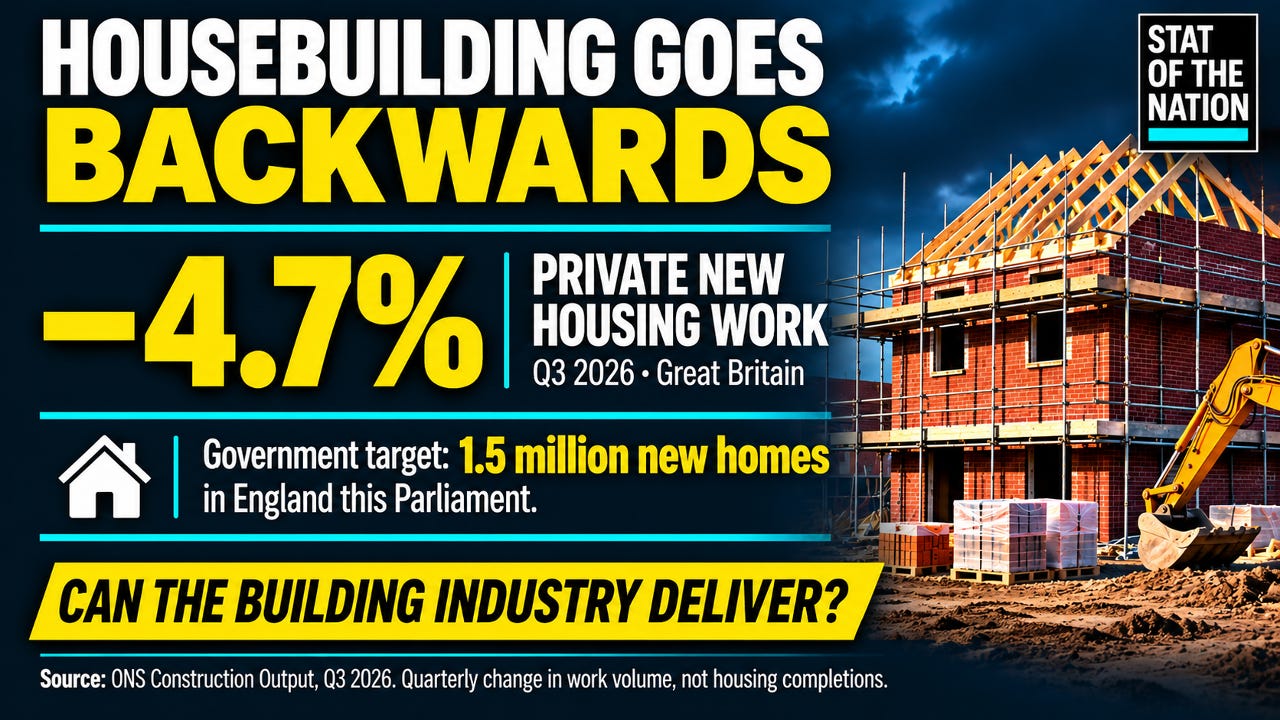
The decline measures the volume of building work rather than completed homes, but it still raises questions about the strength of the housebuilding sector. Higher borrowing costs, construction material prices, labour availability and uncertainty over buyer demand all affect whether new developments are financially viable.
There were some encouraging signs in September, with construction activity recovering and new orders increasing over the quarter. However, much of that additional demand came from projects outside private housing.
Britain needs more homes, but private housebuilding is moving backwards. Government targets are one thing. Delivering the homes is another.
Pubs and Restaurants Face a Sustained Decline
Another area of concern is Britain’s hospitality industry. While much of the services economy is expanding, pubs, restaurants and other food and drink businesses are struggling.
The latest Index of Services figures show food and beverage services contracted by 1.9% during the third quarter. More concerning still, the industry has now recorded five consecutive declines on a rolling three-month basis. This isn’t simply one disappointing month.
Pubs and restaurants face considerable financial pressures, including energy bills, food costs, staffing costs, business rates and employer National Insurance contributions. These are labour-intensive businesses, often operating on tight margins, facing rising costs at a time when households struggling with their own bills may be cutting back on eating out and visiting pubs.
The output figures alone don’t prove exactly what has caused the decline, but the sustained contraction deserves attention. Hospitality businesses provide important employment opportunities, particularly for younger workers, while supporting local suppliers, high streets and communities.
And unlike the growth in specialist technology industries, the economic contribution of a local pub or restaurant is something people can see directly in their own towns and villages.
An economy where technology is booming but pubs and restaurants are struggling presents a very different picture from the overall GDP headline.
The Bigger Picture
Britain’s latest economic figures are encouraging. GDP is growing, output per person is increasing, and technology-related industries are demonstrating considerable strength. It would be wrong to dismiss those achievements simply because they don’t fit a particular political narrative.
But economic growth alone doesn’t tell us whether households are becoming more prosperous.
A bigger economy is welcome. But growth that doesn’t reach people’s pockets isn’t the same as Britain getting better off.
✍️ Thanks for reading Stat of the Nation. If you find my analysis useful, please share or subscribe to support my work.
✍️ Jamie Jenkins
Stats Jamie | Stats, Facts & Opinions
📲 Follow me here for more daily updates: