

For the first time since records began in 1993, cocaine has overtaken heroin or morphine as the most frequently mentioned individual drug in fatal poisonings across England and Wales.
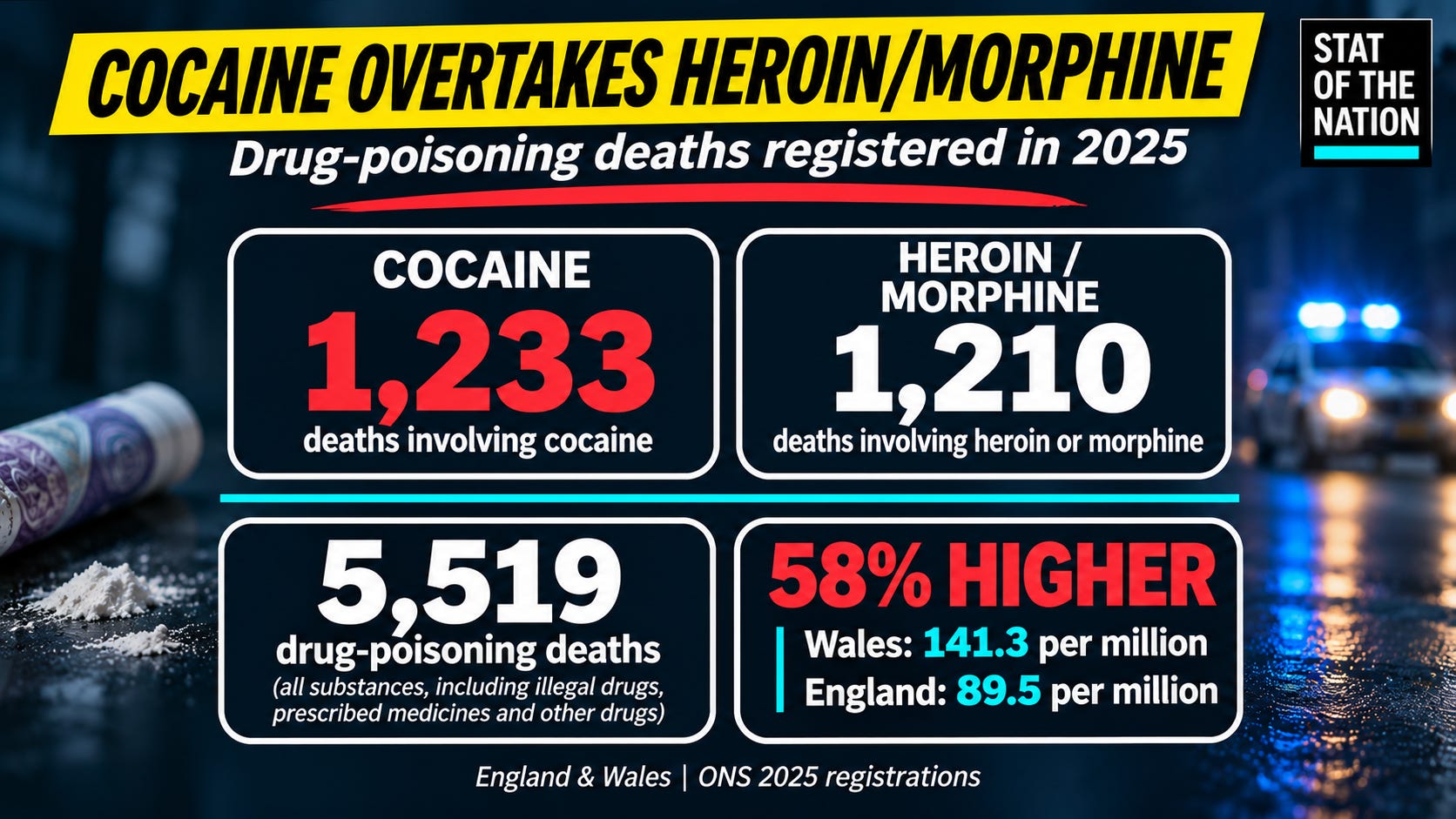
The latest Office for National Statistics figures, published on 4 November, reveal 5,519 drug-poisoning deaths registered in 2025, equivalent to more than 100 every week.
That’s only slightly below the previous year’s record. The mortality rate remains almost twice its 2012 level, while Wales has a death rate 58% higher than England.
The figures reveal a changing drugs market, an ageing generation affected by drug misuse and a problem that remains far from being resolved.
Cocaine Overtakes Heroin for the First Time
The changing pattern of drug deaths is remarkable.
In 2015, heroin or morphine was mentioned in 1,201 deaths, compared with just 320 involving cocaine.
A decade later, that position has reversed.
2015: Cocaine 320 deaths; heroin or morphine 1,201.
2024: Cocaine 1,279 deaths; heroin or morphine 1,415.
2025: Cocaine 1,233 deaths; heroin or morphine 1,210.
Go back to 2010, when there were just 144 registered cocaine-related deaths, and the scale of the change becomes even clearer.
Deaths involving cocaine are now more than eight times higher than fifteen years earlier.
There is, however, an important distinction. Cocaine-related deaths actually fell slightly in 2025, but heroin or morphine deaths declined more sharply, producing the historic crossover.
Opioids also remain the biggest problem when considered as a wider drug category. Opiates and opioids were involved in 2,324 deaths in 2025, accounting for 42% of all drug-poisoning deaths.
And these figures don’t necessarily mean a single substance caused each death. Many fatal poisonings involve combinations of drugs, sometimes alongside alcohol.
Nevertheless, the longer-term growth in cocaine-related deaths is difficult to ignore.
A Small Fall in Deaths — But Don’t Celebrate Yet
There was some encouraging news in the latest figures.
The number of registered drug-poisoning deaths fell from 5,565 in 2024 to 5,519 in 2025, a reduction of just 46 deaths.
The age-standardised mortality rate also declined from 93.9 to 92.4 deaths per million people, the first annual decrease since 2012.
But that needs perspective.
In 2012, the rate was just 46.5 deaths per million.
Drug-poisoning mortality remains almost twice as high as it was thirteen years earlier.
Of the deaths registered in 2025, 3,615 were classified specifically as drug misuse, a narrower measure covering deaths involving controlled substances or specified drug-related disorders. The wider drug-poisoning figures also include deaths involving other medicines and substances.
There is another reason to be cautious about the latest decline.
Nearly 63% of deaths registered in 2025 actually occurred in previous years, reflecting substantial delays in coroners’ investigations.
When the ONS examines deaths according to when they occurred, allowing a consistent period for registration, the mortality rate was unchanged between 2023 and 2024.
So while the small reduction in registrations is welcome, it is too early to conclude that drug deaths are now falling sustainably.
Wales Has a Drug-Death Rate 58% Higher Than England
The geographical differences are particularly concerning.
In Wales, 422 drug-poisoning deaths were registered in 2025, compared with 417 the previous year.
That gives Wales an age-standardised mortality rate of 141.3 deaths per million people, compared with 89.5 in England.
The regional comparison is revealing:
Wales: 141.3 deaths per million.
North East England: 135.2.
England overall: 89.5.
London: 58.3.
Wales recorded a higher rate than every English region in 2025, including the North East, which has historically experienced some of the country’s highest drug-death rates.
And the longer-term trend in Wales is concerning.
Its rate has risen from 109.6 deaths per million in 2022 to 141.3 in 2025.
Meanwhile, the North East’s rate has been considerably more volatile, reaching 174.3 in 2023 before falling to 135.2 in 2025.
We should be careful about interpreting individual annual changes. Death registration delays can distort regional comparisons, particularly when deaths are registered long after they occurred.
In 2025, the median registration delay was 253 days in Wales, compared with 209 days in England.
Nevertheless, the figures demonstrate that drug-poisoning mortality remains persistently high in Wales and the North East.
These are age-standardised comparisons, meaning differences cannot simply be explained by the age structure of populations.
Why are some parts of the country experiencing such substantially higher drug-death rates?
That deserves closer examination of deprivation, addiction treatment, prevention and the wider public health response.
A Changing Drug Crisis — And an Ageing Generation
It isn’t just cocaine that stands out.
Deaths involving synthetic cannabinoids, often associated with substances such as Spice, more than doubled from 44 in 2024 to 95 in 2025.
Ketamine was mentioned in 115 deaths, compared with just seven a decade earlier. Pregabalin, a medicine used to treat conditions including nerve pain and epilepsy, was involved in 581 deaths, more than six times the number recorded in 2015.
Meanwhile, nitazenes, a group of highly potent synthetic opioids, were involved in 150 deaths, down from 195 in 2024 but still almost three times their 2023 level.
But the changing age profile tells another important story.
In the late 1990s and early 2000s, the highest drug-misuse death rates were among people aged 20 to 29.
Over time, that changed:
1990s and early 2000s: People aged 20–29 had the highest rates.
2003 to the mid-2010s: The highest rates shifted to those aged 30–39.
Since 2016: People aged 40–49 have recorded the highest rates.
The ONS identifies this as a pattern consistent with a cohort effect, particularly involving people born during the 1970s, often described as Generation X.
As this generation has aged, the age group with the highest drug-misuse mortality has also become progressively older.
In 2025, people aged 40 to 49 had the highest rate, at 141.4 deaths per million. The average age at death was 45.5 years for men and 48.5 for women, while men accounted for nearly three-quarters of drug-misuse deaths.
This doesn’t mean younger generations are unaffected. Indeed, the death rate among people aged 20 to 29 increased between 2024 and 2025.
But the longer-term pattern highlights the importance of tackling established addiction and drug-related harm among middle-aged adults, alongside preventing problems developing in younger generations.
What About the Gangs Supplying Britain’s Drugs?
We hear plenty from the Government about smashing the gangs. But Britain’s illegal drugs market presents another enormous organised-crime challenge. The National Crime Agency’s 2026 assessment identifies Western Balkan organised crime networks as having the greatest control over the cocaine supply chain into Britain, from international importation to wholesale distribution. These networks have established direct relationships with South American cartels, helping to supply a highly lucrative international market.
And despite substantial enforcement activity, the cocaine market remains resilient. The NCA reports that cocaine seizures increased by more than 440% over the past decade, from 3.4 tonnes in 2015 to 18.5 tonnes in 2025. Yet wholesale prices fell in 2025 while purity remained consistent, pointing towards substantial availability and adaptable supply chains. Seizing more drugs is important, but it doesn’t necessarily mean the underlying supply has been brought under control.
Of course, tackling the drugs problem involves much more than enforcement. It also means preventing addiction, reducing violence and exploitation, supporting treatment and helping people rebuild their lives.
The latest figures reveal some welcome signs, but also show how much remains to be done.
We hear plenty about smashing criminal gangs. But on these figures, we are still a long way from getting to grips with the damage drugs are doing to our communities.
✍️ Thanks for reading Stat of the Nation. If you find my analysis useful, please share or subscribe to support my work.
✍️ Jamie Jenkins
Stats Jamie | Stats, Facts & Opinions
📲 Follow me here for more daily updates:
Another thought provoking set of stats Jamie.
What the figures should show but don’t are what demographic are those who are killed by drugs?
I am guessing in that it’s probably two types.
Those people who are at the bottom of society. The poor with nothing to lose. Those who can’t afford it but use because they assume life is not worth the living. Or they are ill in other ways or just destined like alcoholics to be addicted. They may have to fund their habits from petty crime. And may be influenced by others in their circle or in similar circumstances.
Then there are the second group. Those who earn more. Well in fact. Who start off as a recreational choice rather than a presumed need like group 1.
This second group have money and have it all but the pressure of that chase and peer pressure are the drivers of addiction and overdose.
With young of today not mixing as once they did previously may account for the decline. As drugs can be social. And someone had to be introduced to it.
Professionals in group 2 may have access to other drugs so may account for new mixtures or cocktails of drugs.
But as usual it’s poverty and it excess that creates the breeding ground for drug addiction.
Too many going to university could be a way too carry on the addiction and have time and money to breed addiction.
I think we need more youngsters going straight into work. Not attending university with money and time. I think we need to concentrate on giving young and poor the real chances of homes and jobs and a stake in life. Earlier not later. And we need to make sure we clamp down on low level abuse. Cannabis and smoking and vaping. Come down hard. Zero tolerance. Nip it in the bud.
But alas it’s always going to be the case that poverty and nil chances will breed such addictions. Nothing to lose nothing to gain.
Money wherever it congregates from SPENDING gives the best foundations for a better life worth chasing. An unfair unfunded area or town is never going to get out of that without money and spending going on.
The big cities are wealthy because of the concentration of money being spent. The worst are places of less money less opportunity and no future.
That’s why we need a monetary system that ensures and enforces flow to the point tax take is sufficient to give government all the money it needs to enforce and control files of money.
We need zero tolerance to small starter crimes. That lead to harder time snd bigger crimes.
More police more judges more prison places all from more tax taken from s freer fuller flow of money. Not a stagnant standard still economy if no SPENDING.
We need more if our money being spent than it already has. More if it being spent everywhere that’s my view give hope to those who feel alienated.
More fairness in economic earning, they only comes from all money moving from bring SPENT all the time.
Good read thank you