

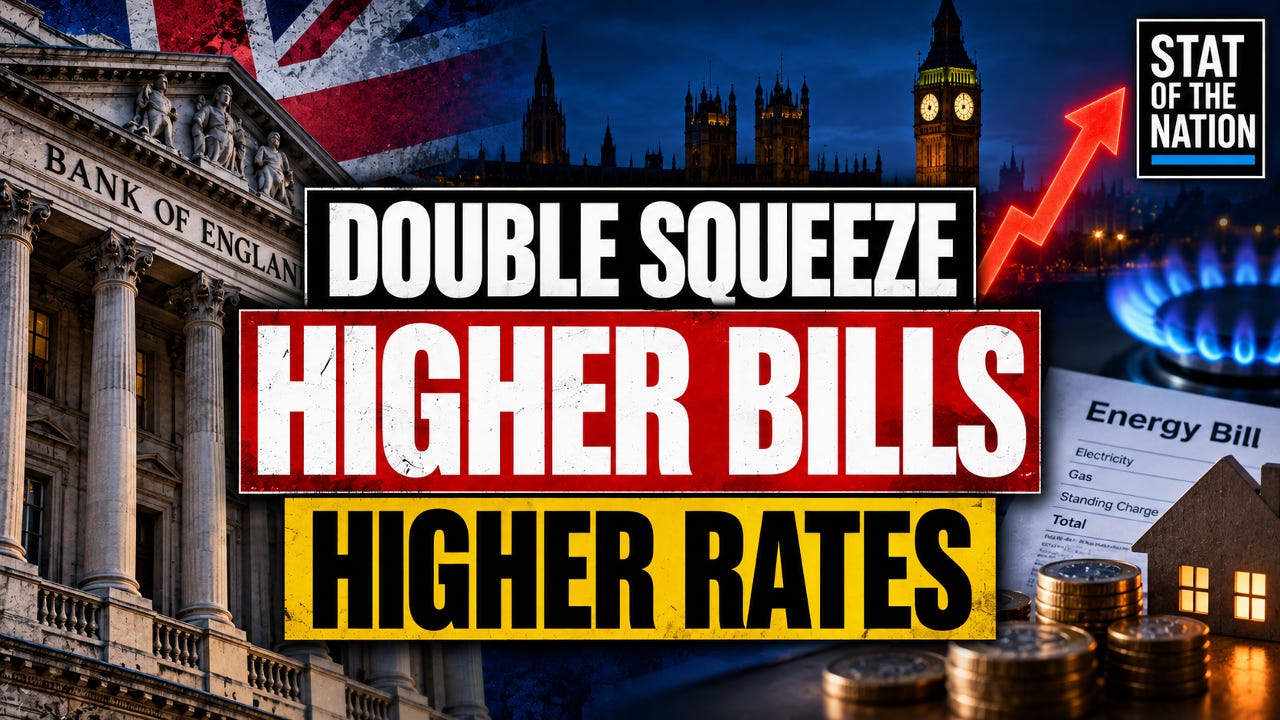
Britain has been here before. Global energy prices rise, inflation follows, and then the Bank of England responds by increasing interest rates.
For households, the result is simple: higher bills and higher borrowing costs. Consumers get hit twice.
And there is a danger Britain could do it all over again.
The Bank Is Talking About Higher Rates Again
Bank Rate currently stands at 3.75%, but three of the nine members of the Bank of England’s Monetary Policy Committee voted in July to increase it to 4%.
Chief Economist Huw Pill was one of them, and this week he again argued for higher rates because of the risk that renewed energy inflation becomes embedded in wages and wider prices.
Yet the Bank itself accepts that monetary policy cannot influence energy prices. Higher rates cannot produce more oil or gas, end conflict in the Middle East or directly reduce the international price Britain pays for energy.
What they can do is increase mortgage payments, make business borrowing more expensive and reduce household spending.
Higher rates work by weakening demand across the economy.
But when the original inflation comes from an external energy shock, consumers are already being squeezed before the Bank acts.
We Have Already Tried This
This is essentially what happened during the last cost-of-living crisis.
Energy prices were already rising sharply during the second half of 2021, before Russia invaded Ukraine, as the global economy reopened after Covid and energy demand rebounded faster than supply.
The Bank said wholesale oil prices were around 80% higher than at the end of 2020, while wholesale gas prices were around 400% higher. European gas stocks had also been depleted following a cold winter.
Russia’s invasion in February 2022 then made an already serious situation considerably worse, sending energy and other commodity prices higher again.
UK inflation eventually peaked at 11.1% in October 2022. Households were paying almost 89% more for electricity, gas and other fuels than a year earlier.
At the same time, the Bank was rapidly increasing interest rates. Bank Rate went from just 0.1% in December 2021 to 5.25% by August 2023.
Millions of households therefore faced soaring energy and food bills alongside rapidly rising mortgage and borrowing costs.
Consumers were hit twice: first by the inflation shock, then by the response to it.
What Can Higher Rates Actually Fix?
There is a case for higher interest rates when inflation is being driven by excessive demand. If households and businesses are spending faster than the economy can supply goods and services, higher rates can cool that demand.
An energy shock is different.
If Britain suddenly has to pay more for imported oil and gas, the country becomes poorer. Households pay more for energy, fuel, food and the wider cost of producing and transporting goods.
Increasing interest rates does not reverse that loss. It adds another squeeze on spending.
That is why the important question is not simply “Is inflation rising?”
It is “Why is inflation rising?”
Even the Bank Accepts the Difference
The Bank’s real concern is what economists call second-round effects — higher energy costs becoming embedded in wages, business pricing and inflation expectations.
That is a legitimate risk. But the Bank’s latest assessment says there has so far been little evidence of significant second-round effects.
It also says the labour market remains loose, demand is soft and underlying inflationary pressures have continued to ease. Six of the nine Monetary Policy Committee members therefore voted to leave rates unchanged in July.
That makes another increase harder to justify. If demand is already weak and there is little evidence that the energy shock is becoming embedded, why impose another squeeze on households and businesses?
The Bank worries about acting too late. It should also worry about doing too much.
Households Pay the Price
Higher rates ultimately mean more expensive mortgages, credit cards, personal loans and business finance. Someone refinancing a fixed-rate mortgage can suddenly find themselves paying hundreds of pounds more each month.
Businesses face higher financing costs too, making investment and expansion less attractive.
So households can be squeezed from both directions: their everyday costs rise because energy is more expensive, while their borrowing costs rise as well.
That does not make Britain richer. It leaves families and businesses with less money to spend and invest.
And Banks Can Benefit
There was another striking feature of the previous period of rapidly rising interest rates.
While households saw borrowing costs increase, major banks enjoyed stronger interest income. Parliament’s Treasury Committee noted significant increases in the net interest margins of Britain’s biggest banks — the difference between the interest they receive and the interest they pay.
Commercial banks also hold large reserves at the Bank of England on which the Bank pays interest.
In 2023, NatWest, Barclays, Lloyds and Santander received more than £9 billion in interest on Bank of England reserves — a 135% increase in a single year.
That £9 billion was not simply profit; banks have funding costs and pay interest to depositors. But the contrast is still uncomfortable.
Mortgage holders were facing sharply higher borrowing costs while billions of pounds in additional interest flowed through the banking system as Bank Rate rose.
Don’t Repeat the Double Squeeze
The Bank of England has a responsibility to stop temporary inflation becoming embedded. But that does not mean every increase in inflation requires higher interest rates.
Britain cannot solve a global energy shock by making mortgages and business borrowing more expensive. When energy prices rise, households are already poorer because they are paying more for the same essentials.
The Bank should require compelling evidence that the shock is feeding into persistent domestic inflation before squeezing the economy again.
We saw what happened last time. Energy bills surged while Bank Rate climbed from 0.1% to 5.25%.
Consumers paid from both directions.
Higher energy costs. Higher borrowing costs.
The double squeeze — all over again.
✍️ Jamie Jenkins
Stats Jamie | Stats, Facts & Opinions
If you found this analysis useful, please share it and subscribe for more.
📲 Follow me here for more daily updates:
Hmmm... as an American I ask "uk has an overheated economy?" Lol. If I was an enemy of the UK and wanted to ensure the UK would decline more than it did in the last 10 years (relative to the US), then sure, I too would raise rates and squeeze every working UK citizen.
No problem. They will all came to the US. You can have your welfare sucking immigrants. We'll take your smartest and most ambitious. We've done it before. 🤦
Er...if households and businesses are spending faster than supplies can meet surely that would mean "stuff" runs out, people/business can't buy it and the economy naturally cools down. So what's the benefit of increasing interest rates? I have never understood the logic of increasing interest rates and making everyone poorer to stop people spending money. Surely things would balance out. And inflation goes up and down regardless!