

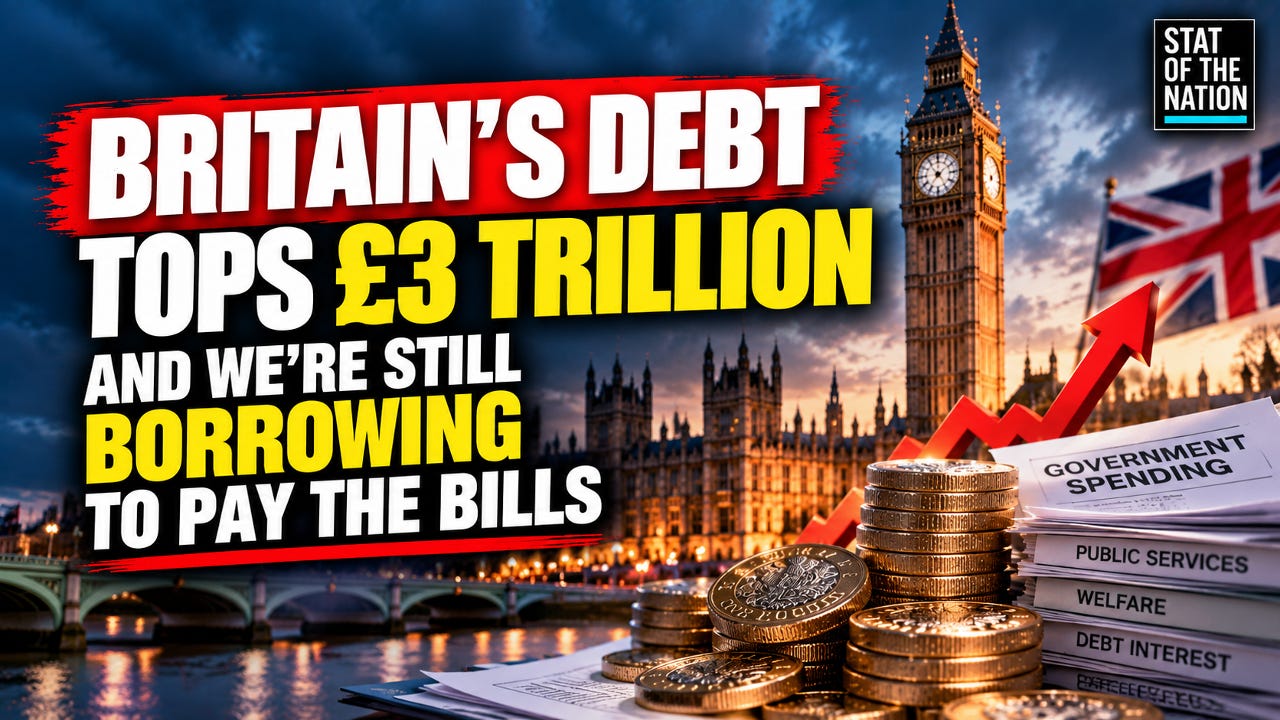
Britain’s national debt has passed £3 trillion for the first time, according to the latest Office for National Statistics figures.
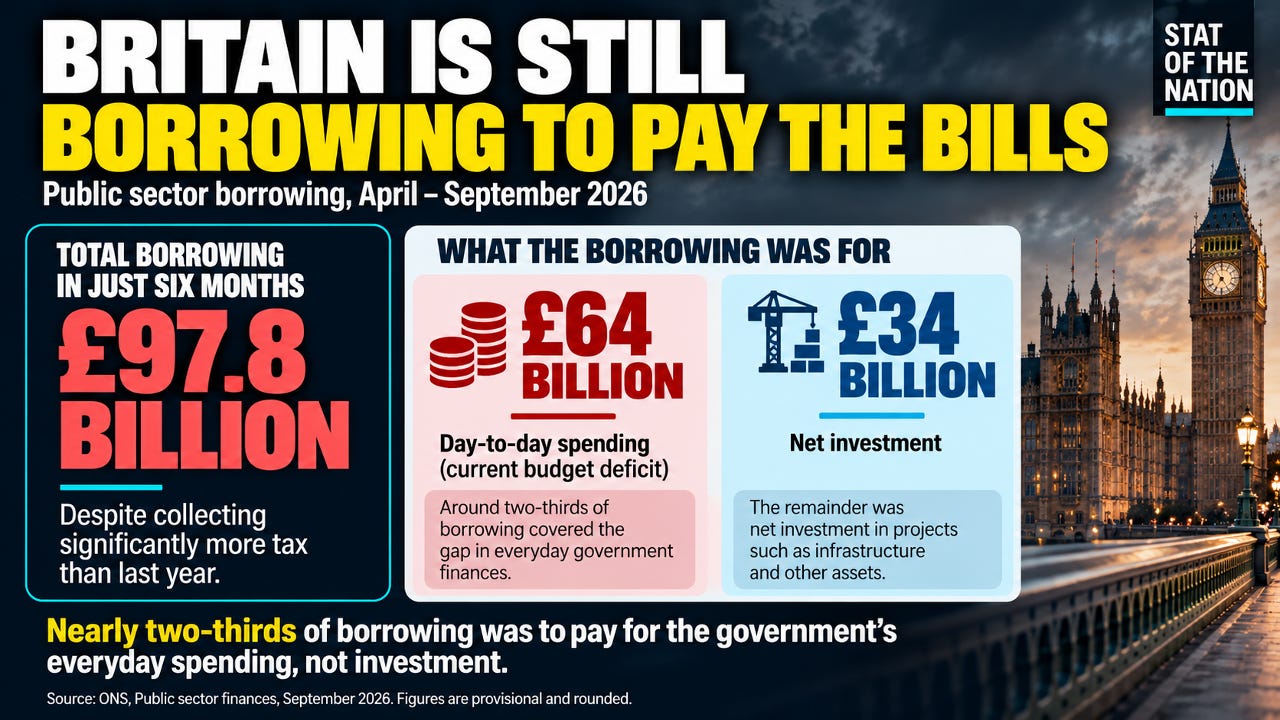
Despite the government collecting substantially more tax, Britain has borrowed almost £98 billion in the first six months of this financial year, including £64 billion to cover day-to-day government spending rather than net investment.
These are extraordinary sums, but the real concern is what lies behind them. Government spending continues to increase, debt interest is absorbing billions, and higher tax revenues have done little to eliminate Britain’s reliance on borrowing.
And ultimately, the consequences affect all of us through the taxes we pay, the public services we receive and the financial choices facing future governments.
Government Spending Keeps Rising
Between April and September, central government collected almost £27 billion more in tax than during the same period last year. Yet over those same six months, government expenditure increased by nearly £31 billion.
To be clear, total government receipts, including National Insurance and other income, grew slightly faster than expenditure. That has helped reduce borrowing compared with last year, but it doesn’t change the substantial pressure coming from government spending.
Much of the increase is being driven by existing commitments, including welfare payments, pensions, public services and the cost of servicing government debt. These are areas where expenditure can continue rising even without significant improvements in what taxpayers receive.
More concerningly, government expenditure was almost £9 billion higher than the Office for Budget Responsibility expected. Higher-than-forecast debt interest and benefit payments, including pensions, were among the biggest pressures.
This is the challenge facing the Chancellor. Even with additional revenue coming into the Treasury, existing spending commitments are proving more expensive than anticipated.
And that raises a fundamental question about whether Britain can continue expanding its expenditure without making much more difficult decisions about priorities, efficiency and what the country can realistically afford.
Borrowing Just to Keep Government Running
Perhaps the most troubling finding is that Britain continues to borrow substantial sums simply to meet its everyday spending commitments.
Of the £98 billion borrowed during the first six months of the financial year, around £64 billion represents the current budget deficit. This is borrowing associated with the day-to-day costs of government, rather than net investment in infrastructure and other assets.
Borrowing to invest in projects that generate long-term economic benefits can make financial sense. But consistently borrowing because current revenues cannot cover current spending creates a very different challenge.
That doesn’t mean the money is being wasted. Healthcare, education, pensions and other public services are important commitments, and governments sometimes have good reasons to run deficits.
Nevertheless, a government that continually relies on borrowing to finance existing commitments risks leaving future taxpayers with an increasingly difficult financial burden.
The current deficit has improved compared with last year, but it remains above forecast. Britain is still living beyond the revenues available to finance its day-to-day public sector activities.
Debt Interest — Billions Spent Before We Improve a Single Service
One of the biggest problems with carrying so much debt is the cost of servicing it.
In the first six months of this financial year, central government incurred almost £61 billion in debt interest. September alone accounted for £10.9 billion, the highest September figure since monthly records began in 1997, although not adjusted for inflation.
Think about what that means. Before the government can allocate additional money to improving hospitals, schools, roads or other public services, it already faces enormous financial obligations arising from money borrowed in the past.
In that sense, debt interest is effectively dead money from the perspective of delivering new public services. It doesn’t employ additional nurses, repair a road or build a school. It is the cost of financing existing debt, including borrowing that may have funded valuable spending or investment in previous years.
And the problem becomes more difficult when interest costs rise. The government must either find more revenue, reduce spending elsewhere or borrow additional money to accommodate those costs.
Inflation adds another complication. As I explained in my earlier article, price pressures are increasing again, affecting households and businesses. Inflation also raises the amount owed on some government bonds linked to the Retail Prices Index, although part of that cost accrues before it is paid.

This is why Britain’s debt burden matters. It’s not simply the enormous amount we owe, but the financial commitments that come with servicing it and the choices those commitments restrict.
Why Should Taxpayers Care?
It’s easy to dismiss national debt as an abstract figure that only economists and politicians need to worry about. But these financial pressures have consequences for ordinary households.
When government spending rises simply to maintain existing commitments, taxpayers can end up contributing more without necessarily receiving better services. Additional funding may be swallowed up by higher costs before improvements in healthcare, education or infrastructure are delivered.
Meanwhile, the more money committed to debt interest, the less flexibility government has to finance other priorities without raising taxes, cutting expenditure elsewhere or borrowing further.
With the Budget approaching on 28 October, the Chancellor faces some difficult choices. Further tax increases could put additional pressure on households and businesses, while meaningful spending restraint requires decisions about government priorities and the effectiveness of public services.
There has been some improvement in the public finances. Borrowing is lower than last year, and national debt has fallen slightly relative to the size of the economy. Those developments are welcome, but they don’t remove the underlying challenge of rising expenditure and continued borrowing.
I don’t believe Britain can simply keep turning to taxpayers whenever government spending commitments become more expensive. We need stronger economic growth, greater scrutiny of expenditure and a willingness to question whether existing programmes are delivering the outcomes they should.
That doesn’t mean cutting spending indiscriminately. It means recognising that governments have limited resources and that every pound allocated to one priority is a pound unavailable for another without raising additional money.
Britain doesn’t just need more tax revenue. It needs to get a much better grip on government spending and demonstrate that taxpayers are receiving value for their money.
Because when we’re collecting billions more in tax, borrowing to meet everyday costs and spending extraordinary sums servicing existing debt, surely it’s time to ask whether the current approach is sustainable.
✍️ Thanks for reading Stat of the Nation. If you find my analysis useful, please share or subscribe to support my work.
I crunch the numbers behind the headlines so you don’t have to.
✍️ Jamie Jenkins
Stats Jamie | Stats, Facts & Opinions
📲 Follow me here for more daily updates:
Oh dear.....they're not too smart this Labour shower.....hand cuffing the UK for the next 30 years!!
I can see my bank manager allowing that !!