

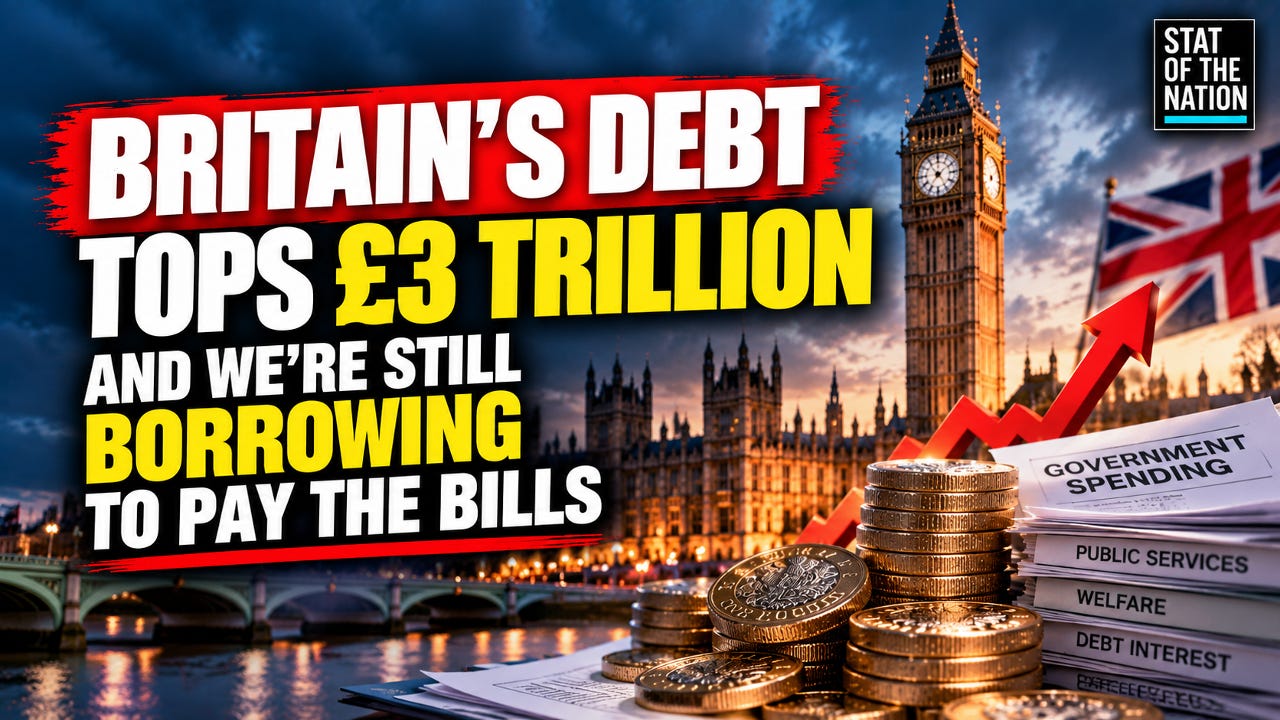
Britain’s national debt has passed £3 trillion for the first time, according to the latest Office for National Statistics figures.
Despite the government collecting substantially more tax, Britain has borrowed almost £98 billion in the first six months of this financial year, including £64 billion to cover day-to-day government spending rather than net investment.
These are extraordinary sums, but the real concern is what lies behind them. Government spending continues to increase, debt interest is absorbing billions, and higher tax revenues have done little to eliminate Britain’s reliance on borrowing.
And ultimately, the consequences affect all of us through the taxes we pay, the public services we receive and the financial choices facing future governments.
Government Spending Keeps Rising
Between April and September, central government collected almost £27 billion more in tax than during the same period last year. Yet over those same six months, government expenditure increased by nearly £31 billion.
To be clear, total government receipts, including National Insurance and other income, grew slightly faster than expenditure. That has helped reduce borrowing compared with last year, but it doesn’t change the substantial pressure coming from government spending.
Much of the increase is being driven by existing commitments, including welfare payments, pensions, public services and the cost of servicing government debt. These are areas where expenditure can continue rising even without significant improvements in what taxpayers receive.
More concerningly, government expenditure was almost £9 billion higher than the Office for Budget Responsibility expected. Higher-than-forecast debt interest and benefit payments, including pensions, were among the biggest pressures.
This is the challenge facing the Chancellor. Even with additional revenue coming into the Treasury, existing spending commitments are proving more expensive than anticipated.
And that raises a fundamental question about whether Britain can continue expanding its expenditure without making much more difficult decisions about priorities, efficiency and what the country can realistically afford.
Borrowing Just to Keep Government Running
Perhaps the most troubling finding is that Britain continues to borrow substantial sums simply to meet its everyday spending commitments.
Of the £98 billion borrowed during the first six months of the financial year, around £64 billion represents the current budget deficit. This is borrowing associated with the day-to-day costs of government, rather than net investment in infrastructure and other assets.
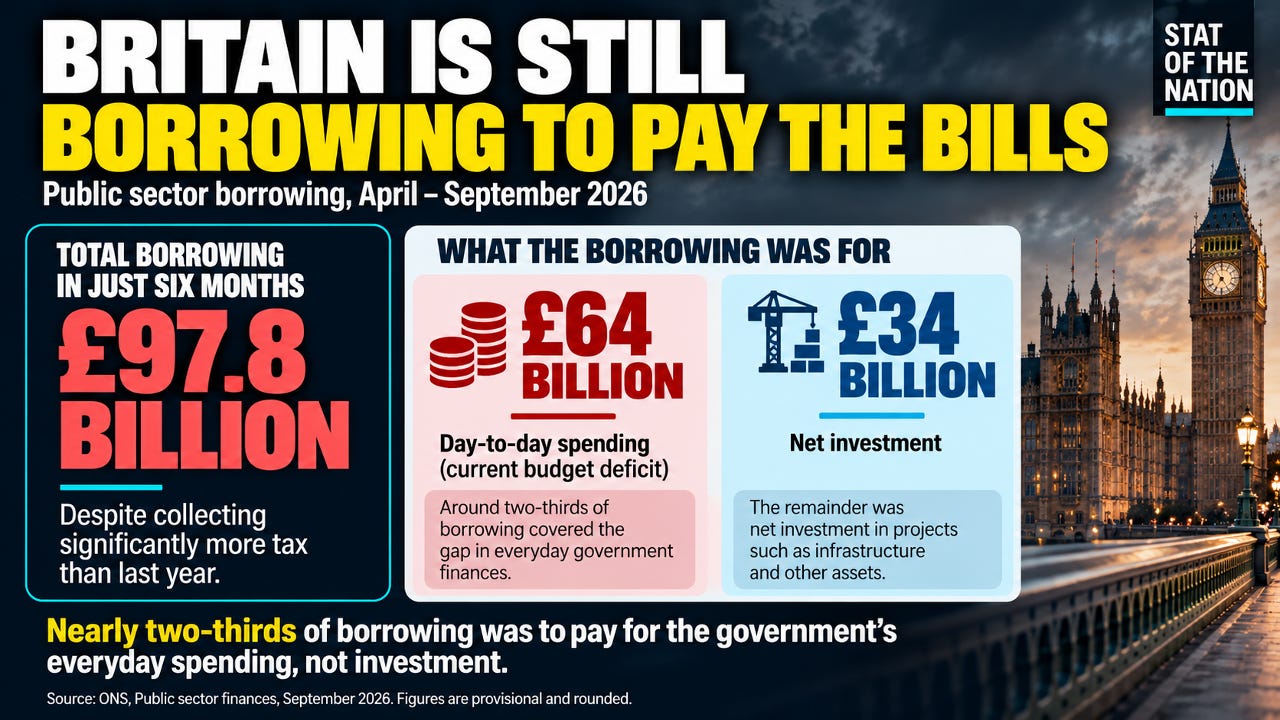
Borrowing to invest in projects that generate long-term economic benefits can make financial sense. But consistently borrowing because current revenues cannot cover current spending creates a very different challenge.
That doesn’t mean the money is being wasted. Healthcare, education, pensions and other public services are important commitments, and governments sometimes have good reasons to run deficits.
Nevertheless, a government that continually relies on borrowing to finance existing commitments risks leaving future taxpayers with an increasingly difficult financial burden.
The current deficit has improved compared with last year, but it remains above forecast. Britain is still living beyond the revenues available to finance its day-to-day public sector activities.
Debt Interest — Billions Spent Before We Improve a Single Service
One of the biggest problems with carrying so much debt is the cost of servicing it.
In the first six months of this financial year, central government incurred almost £61 billion in debt interest. September alone accounted for £10.9 billion, the highest September figure since monthly records began in 1997, although not adjusted for inflation.
Think about what that means. Before the government can allocate additional money to improving hospitals, schools, roads or other public services, it already faces enormous financial obligations arising from money borrowed in the past.
In that sense, debt interest is effectively dead money from the perspective of delivering new public services. It doesn’t employ additional nurses, repair a road or build a school. It is the cost of financing existing debt, including borrowing that may have funded valuable spending or investment in previous years.
And the problem becomes more difficult when interest costs rise. The government must either find more revenue, reduce spending elsewhere or borrow additional money to accommodate those costs.
Inflation adds another complication. As I explained in my earlier article, price pressures are increasing again, affecting households and businesses. Inflation also raises the amount owed on some government bonds linked to the Retail Prices Index, although part of that cost accrues before it is paid.

This is why Britain’s debt burden matters. It’s not simply the enormous amount we owe, but the financial commitments that come with servicing it and the choices those commitments restrict.
Why Should Taxpayers Care?
It’s easy to dismiss national debt as an abstract figure that only economists and politicians need to worry about. But these financial pressures have consequences for ordinary households.
When government spending rises simply to maintain existing commitments, taxpayers can end up contributing more without necessarily receiving better services. Additional funding may be swallowed up by higher costs before improvements in healthcare, education or infrastructure are delivered.
Meanwhile, the more money committed to debt interest, the less flexibility government has to finance other priorities without raising taxes, cutting expenditure elsewhere or borrowing further.
With the Budget approaching on 28 October, the Chancellor faces some difficult choices. Further tax increases could put additional pressure on households and businesses, while meaningful spending restraint requires decisions about government priorities and the effectiveness of public services.
There has been some improvement in the public finances. Borrowing is lower than last year, and national debt has fallen slightly relative to the size of the economy. Those developments are welcome, but they don’t remove the underlying challenge of rising expenditure and continued borrowing.
I don’t believe Britain can simply keep turning to taxpayers whenever government spending commitments become more expensive. We need stronger economic growth, greater scrutiny of expenditure and a willingness to question whether existing programmes are delivering the outcomes they should.
That doesn’t mean cutting spending indiscriminately. It means recognising that governments have limited resources and that every pound allocated to one priority is a pound unavailable for another without raising additional money.
Britain doesn’t just need more tax revenue. It needs to get a much better grip on government spending and demonstrate that taxpayers are receiving value for their money.
Because when we’re collecting billions more in tax, borrowing to meet everyday costs and spending extraordinary sums servicing existing debt, surely it’s time to ask whether the current approach is sustainable.
✍️ Thanks for reading Stat of the Nation. If you find my analysis useful, please share or subscribe to support my work.
I crunch the numbers behind the headlines so you don’t have to.
✍️ Jamie Jenkins
Stats Jamie | Stats, Facts & Opinions
📲 Follow me here for more daily updates:
Your absolutely right to point out that government are spending so much on debt interest. It’s a consequence of a combination of bad decisions by government yes, HS2,PPE, aircraft carriers without planes, Brexit, lockdown payments, stupidly sticking to not increasing income tax, vat etc. you name it they waste it, they all do.
But it’s the borrowing that is causing the biggest headache. Combined with a refusal to increase the big taxes. Crucially over TIME as it compounds the problems by not addressing them.
I have to say Jamie, we are ALL taxpayers! There is no such thing as taxpayers and non taxpayers! It’s fuelling discontent by constantly giving that false impression.
People who are on benefits or pensioners or unemployed or let’s face it unemployable, are all taxpayers! They tend to SPEND ALL their incomes because it’s low! Pensions for example are not even a minimum wage!
But in them SPENDING money in full contribute 100% if income in not only paying vat and duty and other taxes like car tax etc but contribute 100% to onward transmission of money to others like you and me!
We all rely on the SPENDING of others to receive our money! If they DONT SPEND then we don’t get paid!
Jamie it’s got sod all to do with cost. It’s got everything to do with DISTRIBUTION of money triggering more tax as it goes and triggering tax each time that money gets passed on.
Now this next statement if mine is crucial to fully understand Jamie;
WE KNOW SPENDING TRIGGERS TAX REVENUE FOR GOVERNMENT BECAUSE NOT SPENDING TRIGGERS NO TAX WHATSOEVER.
Whatever you may think about our economic position caused by incompetence and misunderstanding in my view that statement is unquestionable.
Now I’m not talking just about government SPENDING I’m talking about ALL SPENDING.
And also you must consider this;
Picture a homeless drunk who begs for money. He is comatose on the village green from downing a bottle of whiskey. According to a calculation I got on the internet ( I don’t know if it true) that sounds correct, he just paid 73% in tax on the profit of the seller and those affects the haulier and their affect and the distillery and their process and costs.
Now I don’t know about that but it sounds plausible. But it’s nearly twice the higher rate taxpayer pro rata of income and contributes 200% to rotation and onward transmission of money flow to you me and everyone else who rely on its velocity to line our pockets!
So Jamie, that’s why we shouldn’t be mad at those who SPEND all their money. Because the trouble is, it’s not their fault. It’s actually the fault of NON SPENDERS who don’t spend all or part of their incomes!
Because it’s their inability to make money glue that causes us the rest of our population to be devoid of that money! And it’s got so bad that money is more or less dried up! As so much money is withheld from our economy that has a voracious appetite for it constantly flowing! So that’s the cause of our problems not SPENDING if GOVERNMENT as they pass on ALL MONEY by SPENDING IT BACK ON US!
No the impasse in our economy is the vast sums of our collective money sitting in BANK ACCOUNTS here and abroad doing absolutely nothing for us our needs for money and the triggering if sufficient tax because…..
ALL TAXES ARE TRIGGERED BY SPENDING! Yes even income taxes are TRIGGERED not by working but by SPENDING OF MONEY. No amount of work effort or employment or promise of money will ever trigger tax without first MONEY CHANGES HANDS by choice or need or demand by the act of SPENDING so money actually gets paid in wages.
This is also a true statement! Jamie It’s unquestionable!! It cannot be argued with because tax is triggered by the money getting SPENT first in the chain of events to pass money to employees by employers. It’s a chain of events that cause money to flow.
Income tax may have ‘income’ in the heading. It may be calculated on wages. It may be a liability if the person being paid. We may get Bernie Madoff style statements confirming that tax was paid by the employee, but in fact
IT WAS PAID BY THE EMPLOYER! Not by the employee!
IT WAS FUNDED BY THE SPENDING if the customers and patrons and consumers of that business who had to have SPENT their money to ensure that business and those employers and employees can have that payment if money!
This again Jamie is a true statement! It’s unquestionable! It can’t be argued! It’s a fact.
So let’s recap.
There are not taxpayers or non taxpayers. Only SPENDERS and NON SPENDERS.
Government is crucial in the pass the parcel of money. It takes taxes and spends on us. We get that fluency others SPENDING. We rely on SPENDING. Without it we don’t get it! If we are short of money it’s because of NOT SPENDING. And ALL TAXES are triggered by SPENDING!
So to get sufficient tax revenue we can’t cut spending! No!! In fact we need to increase both government and our SPENDING.
And because we all need money every month it’s time critical. So it has to all happen in a month. Every month.
So it’s a four dimensional glue that’s required for any economy to work. Two dimensional accounting can never reach the Heineken parts for a four dimensional problem!
I truly hope this explains better how any economy should work. By cash money or digital money flowing permanently and perpetually.
But if you need any clue then look no further than the rules I list above. If money needs to flow by SPENDING and ALL TAXES are triggered by SPENDING then the answer to higher yields if tax is yes, more SPENDING of the MONEY that hitherto isn’t being SPENT! Yes MONEY that is idle, unspent, unused and hoarded sitting in bank accounts everywhere. That’s the pot of money! The untapped pit of vast sums NOT BEING SPENT each month.
Or as a currency issuer the government can just produce enough money to make sure sufficient is always in the economic pot to raise sufficient tax!
What makes this worse is the that any income left over isn't really spent on useful infrastructure investment is it ? Its spent on Ukraine, foreign aid , vanity projects: ; like HS2 and asylum commitments. When the last time a major trunk road was built , or a substantial amount of affordable housing? A new hospital or a school so they can indoctrinate more children. I don't trust any of them I will 'lend' my vote to Tories Mark 2 (Reform) although I am not convinced even they have a handle on the dire situation but I am prepared to give them a go