

Britain is having fewer babies.
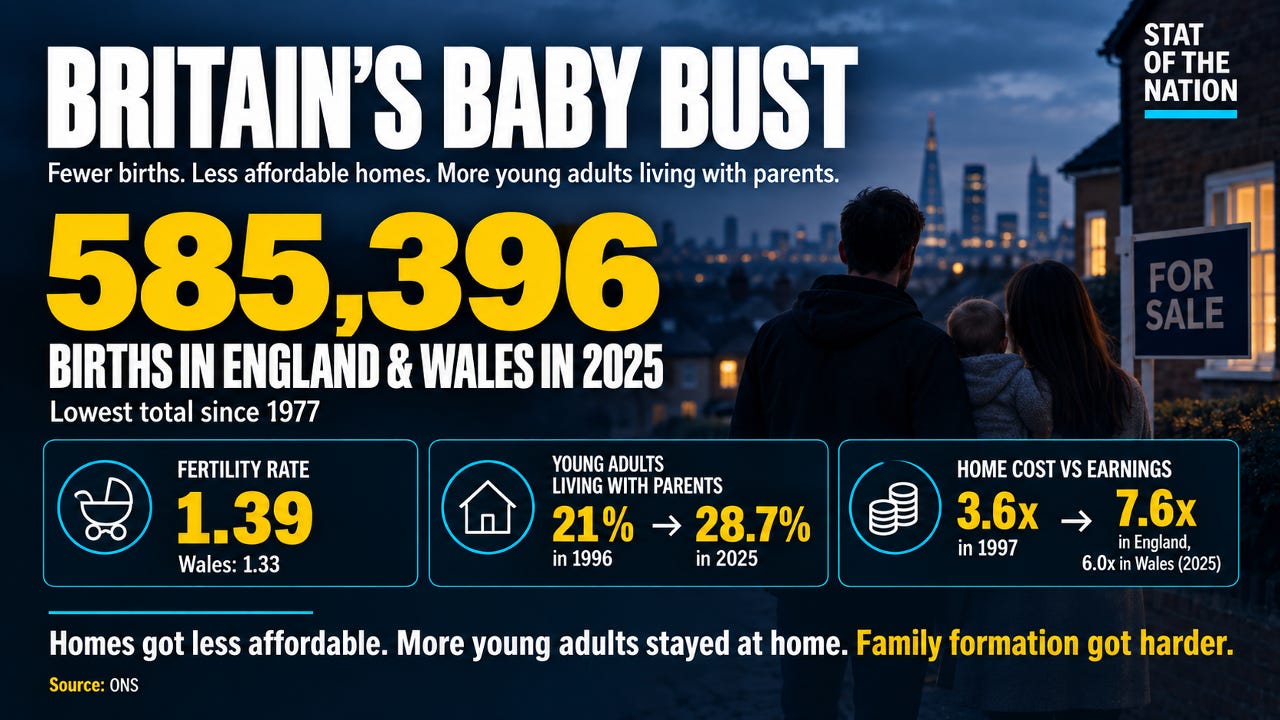
New figures from the Office for National Statistics show there were 585,396 births in England and Wales in 2025 — down 1.6% in a year and the lowest number since 1977. The fertility rate has fallen to just 1.39 children per woman, while in Wales it is even lower at 1.33.
People are also having children later. The average age of mothers is now 31.1, while fathers average 34.0.
But the birth-rate story is not just about changing attitudes towards parenthood. It is also about whether younger adults can afford to leave home, establish independent households and start families.
And that brings housing and immigration into the same story.
The Vicious Circle
The argument is fairly simple.
Britain does not build enough homes.
Population growth adds more housing demand.
Housing becomes harder and more expensive to secure.
More young adults remain with parents or spend heavily on rent.
Family formation is delayed and birth rates fall.
Britain ages and needs more working-age people.
Immigration becomes part of the answer.
More people then need more homes.
And the cycle begins again.
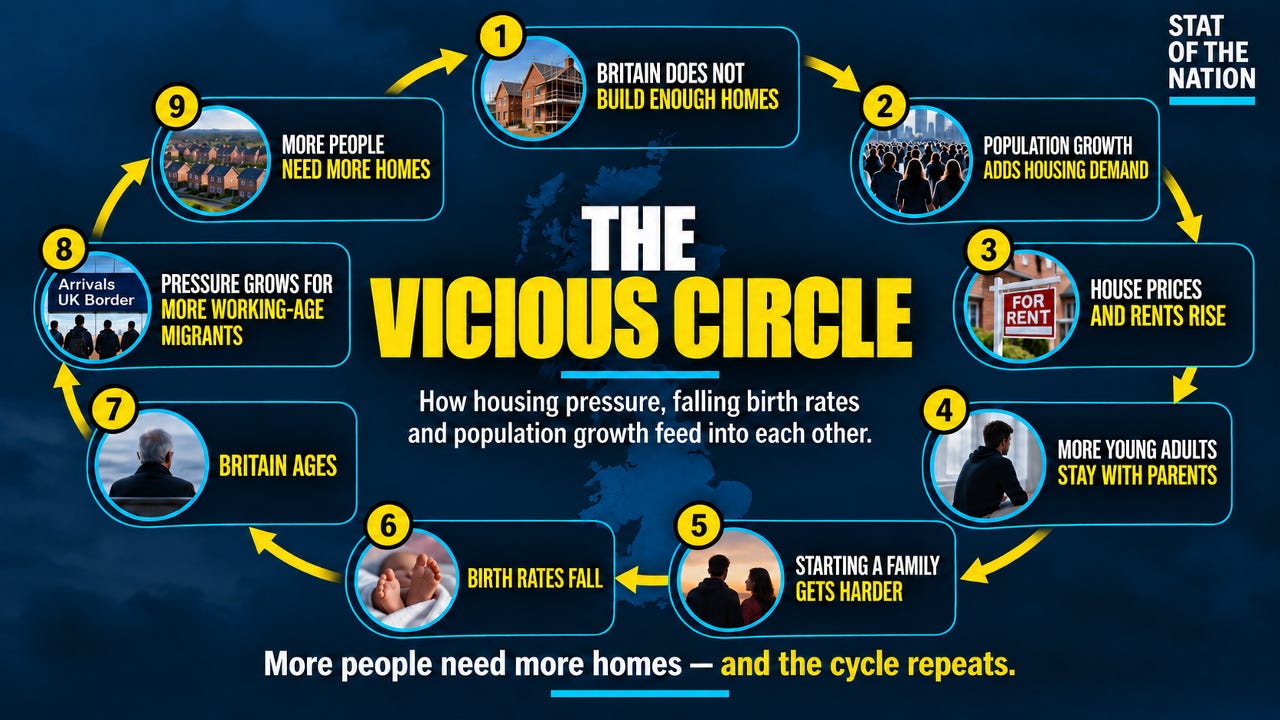
Not every link can be given a precise causal percentage, but the wider pattern is worth examining.
More Young Adults Are Living With Their Parents
Go back to 1996 and around 21% of 20-to-34-year-olds were living with their parents.
By 2025, that had risen to 28.7% — from roughly one in five young adults to nearly three in ten. Among men aged 20 to 34, the figure is even higher at 34.9%.
There are several reasons behind that change. People spend longer in education, relationships tend to happen later and some younger adults deliberately remain at home to save money.
But look at what has happened to housing affordability over almost exactly the same period.
Homes Have Become Far Less Affordable
In 1997, the average home in England and Wales cost around 3.6 times a full-time worker’s annual earnings.
By 2025, the median house-price-to-earnings ratio was 7.6 times earnings in England and 6.0 times earnings in Wales.
So across roughly one generation, buying a home has gone from costing around three to four years of earnings to six, seven or more.
Over that same period, the proportion of young adults living with their parents has risen substantially.
That does not mean house prices explain every young adult still living at home. But it does mean the economics of establishing your own household have become much tougher than they were for the generation before.
And for people unable to buy, the alternative is often expensive private renting. The choice for many younger adults increasingly becomes staying with parents for longer or spending a large share of their income on rent.
Neither makes starting a family easier.
Housing Appears to Matter for Births
There is evidence that these financial pressures affect decisions about having children.
The Resolution Foundation, an independent economic think tank, looked at the changing fertility patterns of younger generations earlier this year. Among childless 32-year-olds, 30% of women and 25% of men said financial reasons were stopping them from trying for children.
Its analysis also found an association between the increase in young adults living with their parents and rising childlessness among some groups of younger women.
That does not mean everybody living with Mum and Dad would otherwise be having children. But the broader point is difficult to dismiss: if people struggle to afford an independent household, establishing a family becomes harder too.
Britain Has Increased Its Population Without Building Enough Homes
Housing is ultimately a question of supply and demand.
For decades Britain has struggled to build enough homes, particularly in the places where people most want or need to live. At the same time, the population has continued to grow, with international migration making an increasingly important contribution to that growth.
That matters because additional population means additional demand for somewhere to live.
More people need more homes. If the population grows faster than the housing stock, demand increases faster than supply. That puts upward pressure on house prices and rents.
The issue is therefore not simply immigration on its own. It is what happens when sustained population growth is combined with a housing system that fails to expand quickly enough.
If Britain wants a larger population, whether through natural growth or migration, it needs to build the homes and infrastructure to accommodate it.
Otherwise housing becomes scarcer, more expensive and harder for younger adults to secure.
Then the Demographic Problem Comes Back Around
This is where the circle becomes particularly important.
Britain’s low birth rate means the population is ageing. ONS projections suggest that between 2024 and 2034 there will be around 6.4 million births but 6.85 million deaths — around 450,000 more deaths than births.
Deaths are projected to exceed births from around 2026 onwards. Without migration, Britain’s population would therefore begin to shrink.
At the same time, the pension-age population is increasing. That means fewer working-age people relative to those requiring pensions, healthcare and social care.
Governments then face an obvious response: bring in more working-age people.
There is an economic logic to that. But if population continues to increase without the housing supply increasing alongside it, pressure on homes increases again.
And that brings us back to the beginning of the cycle.
Migration Is Changing Britain’s Births Too
Migration also affects Britain’s demographics through the children born after people settle here.
In 2025, 34.6% of babies born in England and Wales had a mother born outside the UK, while 40.2% had at least one parent born outside the UK.
India remained the most common country of birth for both mothers and fathers, followed by Pakistan and Nigeria.
Historically, non-UK-born women have also had higher fertility than UK-born women, although the latest robust ONS comparison is from 2021.
The broader point is simple: migration changes Britain’s population not just through people arriving, but through the families they go on to have here.
Over time, that also changes the demographic makeup of the country.
Britain Is Chasing Its Tail
This is the contradiction politicians rarely join together.
We are told Britain needs immigration because the domestic birth rate is too low. There is truth in that: fewer births and an ageing population mean fewer workers supporting a growing retired population.
But population growth also increases housing demand. If Britain continues increasing its population without increasing housing supply sufficiently, prices and rents come under more pressure.
That makes it harder for younger adults to leave home, establish independent households and, for some, start families.
Birth rates then remain low, strengthening the argument that Britain needs more working-age migrants.
And the cycle continues.
The answer is not simply more immigration or zero immigration. Britain needs to tackle the underlying problems together: build more homes, make it easier for younger adults to establish independent households, and make having children financially achievable for people who actually want them.
And if governments decide Britain needs substantial immigration, housing and infrastructure need to expand alongside the population.
Because a fertility rate of 1.39 is not just a statistic about babies. It is a warning about Britain’s future workforce, housing market, public finances and population.
✍️ Jamie Jenkins
Stats Jamie | Stats, Facts & Opinions
If you found this analysis useful, please share it and subscribe for more.
📲 Follow me here for more daily updates:
My first house was £900 ! married ione year one child - had another after two years was earning less than £10 pw ( my wife didn't work) Mortgage on the £300 I borrowed (our parents gave us the the rest) was 8.25% This was 1970 and we ate well and enjoyed life
You know, if they think letting in millions of immigrants will help pay for the old folk they are not looking properly at who they are letting in. The immigrants from the sub-continent and Africa are mostly not brain surgeons or entrepeneurs are they? They are low skilled, low paid and often dependent on benefits. So they take social housing because the government prioritises immigrants into social housing. So the idea that the native birth rate is falling so the native population is getting smaller so the tax receipts and care workers are disappearing so we need to import people to replace the babies not being born misses the point. Most young native women want to have children - many appear to want to be quite traditional and stay at home with babies - but mortgages and rents are too high to allow this. There are plenty of homes but they are not available for native workers who are not entitled to benefits because they go to work and are expected to buy or privately rent those homes. I know people who have low paid jobs who should be entitled to social housing (and would have been once upon a time) because they will never afford a mortgage. They get given a months' rent and a deposit and told to find private rented accommodation. They are then removed from the social housing list and the social housing units go to foreigners, drug addicts, unemployed, travellers and all those people who don't pay in. Then there are the London boroughs who buy up housing estates outside London and relocate their (mostly immigrant) tenants. That takes away housing and imports social issues. We don't need more housing. We need a fairer system and a halt to immigration.