

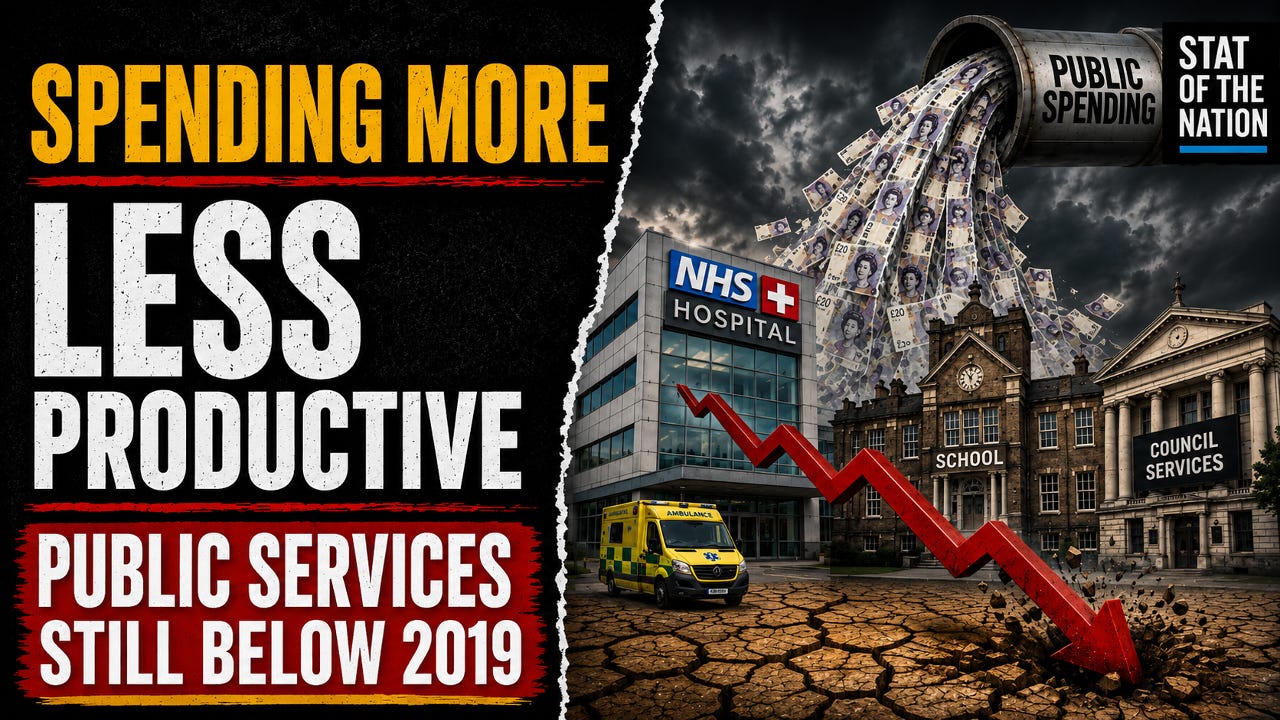
There is a fairly simple question we should ask whenever politicians announce billions more for public services: what are we actually getting for the money?
The latest figures from the Office for National Statistics show that, in 2025, overall UK public-service productivity was still 2.5% below where it was in 2019. For healthcare, it was 5.8% lower.
There has been a recovery since Covid, and that matters. But after five consecutive years of improving productivity, Britain still has not got back to where it was before the pandemic.
That should be a much bigger part of the debate about how we fund the state.
What Does Productivity Actually Mean?
This sounds more complicated than it is. It isn’t a measure of whether individual nurses, teachers or civil servants are working hard enough.
It is essentially asking: how much public service are we getting for the resources going in?
Those resources include staff, buildings, equipment, goods and services. The outputs are things such as hospital treatments, GP appointments and education.
If output rises faster than the resources required to deliver it, productivity improves. If resources rise faster than output, productivity falls.
We spend a lot of time talking about how much government spends. We spend far less time asking what that spending actually delivers.
Why Did Productivity Collapse During Covid?
Covid was an extraordinary shock, but the fall in productivity was also partly the result of choices government made about how to respond.
Schools were closed, non-urgent NHS activity was delayed or cancelled and normal public services were heavily disrupted. At the same time, huge additional resources were poured into the public sector.
In 2020, public-service output fell 7.4%, while inputs increased 9.2%. Healthcare productivity fell 23.0% and education productivity 26.1%.
So this was not simply public-sector workers suddenly becoming less productive. Government deliberately restricted large amounts of normal activity while simultaneously increasing the resources going into the system.
The bigger question now is whether some Covid-era working practices and expectations became embedded. Hybrid working is the obvious example. That does not automatically mean lower productivity, but Covid clearly changed how parts of the public sector operate.
The fall in 2020 is relatively easy to explain. Why productivity is still below 2019 six years later is the more important question.
Five Years of Recovery — And Still Below 2019
Let’s be fair about the figures. Public-service productivity increased by 0.7% in 2024 and another 0.9% in 2025.
In 2025, public-service output increased by 1.7%, while inputs increased by 0.7%. That is exactly what we want to see: more being delivered without resources growing at the same rate.
And 2025 marked the fifth consecutive year of improving productivity following the huge disruption caused by Covid.
So this isn’t a story about productivity currently collapsing. The story is how slowly Britain is recovering what it lost.
After five years of improvement, public-service productivity was still 2.5% below its 2019 level.
Think about that. We aren’t trying to beat some ambitious new benchmark, we are still trying to get back to where we were before Covid.
The NHS Numbers Are Worse
Healthcare is particularly important because it is the biggest part of measured public-service expenditure, and again there has been improvement.
Healthcare productivity increased by 1.1% in 2024 and 1.0% in 2025. Healthcare output rose 2.2% in 2025, compared with a 1.1% increase in inputs.
That is good news. But despite those improvements, healthcare productivity remained 5.8% below its 2019 level.
Nearly six per cent, and remember the comparison. This isn’t the NHS of today being judged against some distant period decades ago. It is being compared with 2019.
That is why I get frustrated when every NHS debate immediately becomes a bidding war over who will spend the most money. Of course funding matters, but surely we also need to ask why a health service receiving enormous resources is still producing less output for those resources than it did before the pandemic.
Simply putting more money in cannot be the only answer.
The Latest Improvement Is Still Small
The ONS has also looked at the latest four quarters, covering April 2025 to March 2026.
Across public services, productivity increased by 0.5%, with output rising 1.7% and inputs increasing 1.2%. Healthcare productivity increased by just 0.4%.
Again, the direction is positive, but the improvement remains modest.
Healthcare output increased by 2.1%, while inputs increased by 1.8%. So more is being delivered, but it is also taking considerably more resource to deliver it.
That leaves only a small productivity gain.
The State Is Not Short of Resources
This is where the wider picture matters, because government spending is already enormous.
Latest Treasury figures show Departmental Expenditure Limit spending reached around £640 billion in 2025/26, up 3.8% in real terms on the previous year. Day-to-day departmental spending alone was almost £497 billion.
Around 6.19 million people were employed in the public sector in March 2026, roughly 37,000 more than a year earlier. Public-sector regular pay was also growing at 5.5%, compared with 2.9% in the private sector, although the timing of NHS pay awards influenced that comparison.
Now, these measures are different. You cannot simply point at higher spending and say it caused weak productivity, it doesn’t work like that.
But we can ask a perfectly reasonable question: if the state keeps consuming more money, employing more people and paying higher wages, when should taxpayers expect a much bigger improvement in what it delivers?
There is a limit to how much more government can tax, borrow and spend without asking whether it is getting enough back.
Stop Confusing Spending With Success
This, for me, is the bigger point.
Success in government is too often measured by how much money has been announced: another £1 billion here, another £5 billion there, more staff, a bigger NHS budget.
But spending is an input, not an achievement.
The achievement is what we get back: more patients treated, shorter waits, better education, faster decisions and public services that work.
The latest ONS figures show some progress, but overall public-service productivity is still 2.5% below 2019, while healthcare remains 5.8% below.
The Covid collapse is relatively easy to explain. The harder question is why, nearly six years later, we still haven’t fully recovered.
Government now needs to focus far more on productivity: cutting bureaucracy, using technology better, reviewing working practices and making sure additional spending actually delivers additional output.
Because there are ultimately only three ways to fund an ever-more-expensive state:
Tax more. Borrow more. Or become more productive.
Britain has spent too long relying on the first two.
Getting back to 2019 should not be considered success. Taxpayers already put an extraordinary amount into the British state — they should expect an extraordinary amount back.
✍️ Jamie Jenkins
Stats Jamie | Stats, Facts & Opinions
If you found this analysis useful, please share it and subscribe for more.
📲 Follow me here for more daily updates:
Can we measure how much input was spent on private sector profit in the NHS as opposed to genuine productivity ie improving patients' health both in 2019 and 2025?
Thanks Jamie for highlighting that spending is an input, not an outcome! It's crazy to think that productivity has not been restored since 2019. Clearly, they are doing something wrong, and why are they not following other more successful examples, such as Poland and Ireland.