

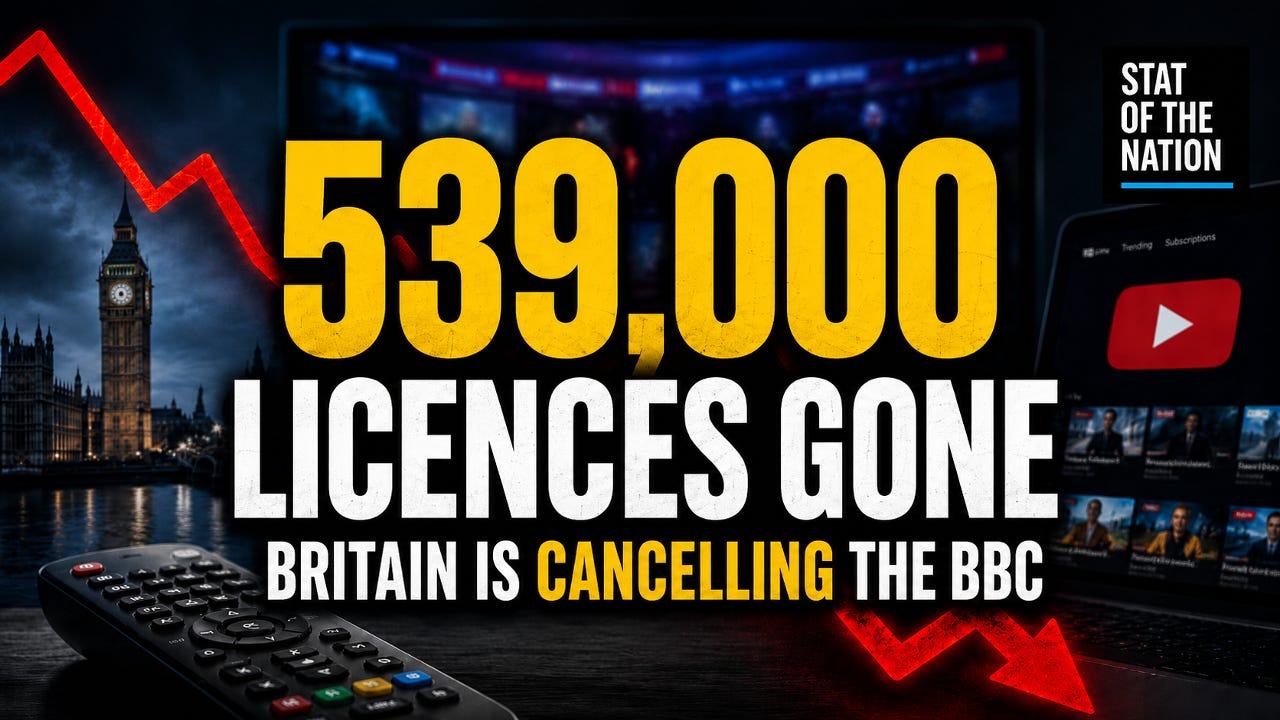
Another 539,000 television licences disappeared last year, following a fall of more than 300,000 the year before. The decline is not merely continuing; it is accelerating.
Not every missing licence represents somebody deliberately contacting TV Licensing to cancel. Some licences expire because people move home or die. But the wider story is clear: more households are deciding they no longer need or want a television licence, and many are legally arranging their viewing so they do not have to pay it.
The reasons will be familiar to millions of people. They rarely watch scheduled television, their children watch YouTube rather than traditional channels, and they already pay for Netflix, Amazon Prime or Disney+. They simply do not believe another £180 charge offers them enough value.
The audience has not stopped watching content. It has simply moved on.
Why People Are Cancelling
The BBC still raises around £3.9 billion a year from the licence fee, but the number paying is falling rapidly.
There is a legitimate issue around evasion. Anyone watching live television or using BBC iPlayer is legally required to hold a licence. Yet evasion is only part of the story.
Millions of people now consume television, news and entertainment without watching live channels or using iPlayer. They use streaming services, YouTube, podcasts and social media instead, and may watch hours of content every week without legally needing a television licence.
That is not a loophole. It is consumer choice.
Ask people why they have cancelled and the answers are usually familiar:
They rarely watch the BBC or live television.
Their children mainly watch YouTube and streaming content.
They already pay for several subscriptions.
They do not believe the BBC provides £180 of household value.
They object to funding the BBC simply to watch another broadcaster live.
More people are therefore looking at the licence fee and asking a simple question: what exactly am I paying for?
The Audience Has Moved Online
The licence fee was designed for a world with only a handful of television channels. Families watched programmes when broadcasters chose to show them, while Netflix, YouTube and the modern creator economy did not exist.
That world has gone. People can now choose from thousands of broadcasters, journalists, podcasters, entertainers and independent creators. They decide what to watch, when to watch it and who they trust.
There is also likely to be a generational effect. Older audiences remain more attached to traditional television, while younger viewers are more likely to begin with YouTube, TikTok, podcasts and streaming services.
The annual report does not tell us exactly how much of the decline is caused by older licence holders dying and younger households not replacing them. But the direction is obvious: the habit of automatically buying a television licence when setting up a household is weakening.
The BBC Is Following Its Audience
The BBC understands this. In January 2026, it announced a partnership with YouTube to produce content specifically for the platform.
That is sensible. The BBC should publish wherever audiences choose to watch, develop digital-first programming and compete for younger viewers.
But there is a contradiction. At the same time as the BBC moves onto YouTube, the government is considering whether public-service broadcasters and designated “trustworthy” news organisations should receive greater prominence online.
These proposals are still under consultation, but they should not proceed.
YouTube is not an electronic programme guide with a limited number of channel positions. It is an open platform containing established broadcasters, independent journalists, specialist organisations and millions of individual creators.
The BBC already enters that market with enormous advantages:
Around £3.9 billion in annual licence-fee income.
One of Britain’s most recognisable brands.
National television and radio networks.
Decades of publicly funded archives.
Major production and marketing resources.
It does not also need government-backed prominence over independent competitors.
If the BBC makes content people value, viewers will watch, subscribe and share it. YouTube will then recommend more of it, which is how every other creator builds an audience.
The BBC has every right to enter the race, but it should not expect the government to move the starting line.
Let Audiences Choose
The government argues that promoting trusted news could make reliable information easier to find. But that raises an immediate question: who decides which organisations deserve that status?
Large broadcasters can produce excellent journalism, but they can also make serious mistakes. Being established does not guarantee accuracy, while being independent does not automatically make someone unreliable.
Trust should be earned through evidence, transparency and correcting errors. It should not be granted simply because an organisation already occupies a privileged place in the broadcasting system.
Illegal content should be dealt with under the law, and platforms will continue to enforce their own rules. But lawful journalism and opinion should not be pushed down simply because it comes from outside the established broadcasting system.
People should be free to create lawful content, audiences should be free to decide what they want to watch, and broadcasters should have to earn their attention.
The Licence Fee Is No Longer Fit for Purpose
One response to the decline could be to widen the number of households required to pay.
There have been suggestions that households using Netflix or YouTube could eventually be required to contribute towards the BBC, even if they do not watch live television or use iPlayer.
That would not modernise the licence fee. It would simply expand it.
A household buying Netflix is paying for Netflix, while someone watching an independent creator on YouTube is choosing that creator. It does not follow that either should also be compelled to fund the BBC.
The question should not be how to force departing households back into the payment base. It should be what funding arrangement makes sense in a media market built around choice.
Another 539,000 licences disappeared in a single year, and behind that number are hundreds of thousands of household decisions. Some rarely use the BBC, others have abandoned live television entirely, and many believe the licence offers poor value. Younger audiences are increasingly organising their viewing around streaming and independent creators.
Those decisions are adding up to a national verdict: the licence fee is no longer fit for the media market Britain actually has.
The BBC is right to follow audiences online, but it should compete for their attention rather than receive privileged treatment because it occupied a privileged position in the analogue age.
The public is already voting with its remote control and with its wallet.
The BBC is welcome on YouTube. But it should have to win the click.
✍️ Jamie Jenkins
Stats Jamie | Stats, Facts & Opinions
📢 Call to Action
If this helped cut through the noise, share it and subscribe free by entering your email in the box below and get the stats before the spin, straight to your inbox (no algorithms).
📚 If you found this useful, you might also want to read:
The Snowflake Generation, One Million Children Referred For Mental Health Support

More than one million children in England had an active referral to mental-health services in 2024–25.
📲 Follow me here for more daily updates:
You forgot to mention that people cancel their licence because the BBC is seen by many to be a government propaganda unit! It also makes politically-correct and tediously boring programmes which lecture the audience rather than entertain, educate or inform them. I suspect that many people simply no longer trust the BBC.
Most of the people I know who have cancelled are not prepared to listen to government sponsored lies and propaganda any longer and they have the audacity to expect us to pay for it.