

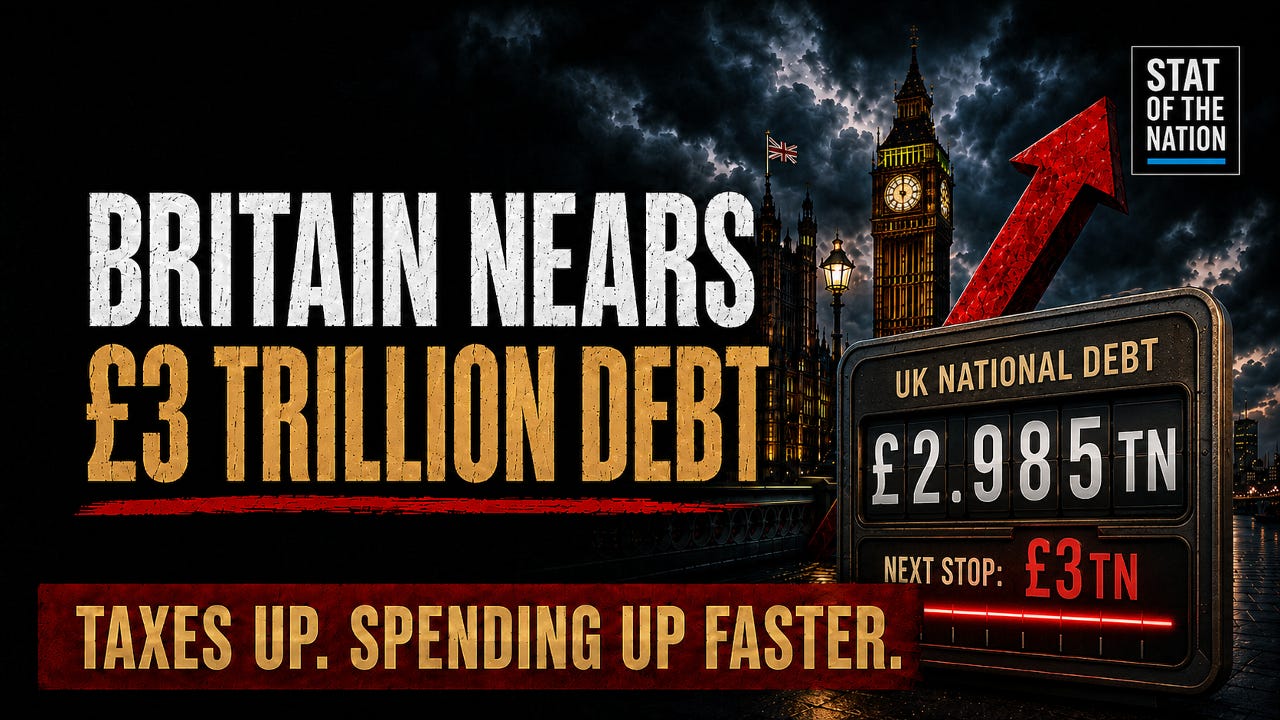
Britain is getting remarkably close to another fiscal milestone. Not a good one.
Latest figures from the Office for National Statistics put public sector net debt at £2.985 trillion at the end of July.
That leaves Britain only around £15 billion away from £3 trillion of debt.
Over the past twelve months alone, the debt total has increased by £95.9 billion.
There is nothing economically magical about crossing £3 trillion, but it is an extraordinary marker of just how accustomed Britain has become to living with enormous levels of government debt.
Britain Is Still Borrowing
There is some better news in the figures, and it is important to acknowledge it.
The public sector borrowed £56.7 billion between April and July, which was £6.0 billion less than during the same four months last year.
So borrowing is moving in the right direction compared with 2025.
But there is another comparison that matters: the Government is still borrowing more than had been expected. The April-to-July total was £2.3 billion above the Office for Budget Responsibility forecast.
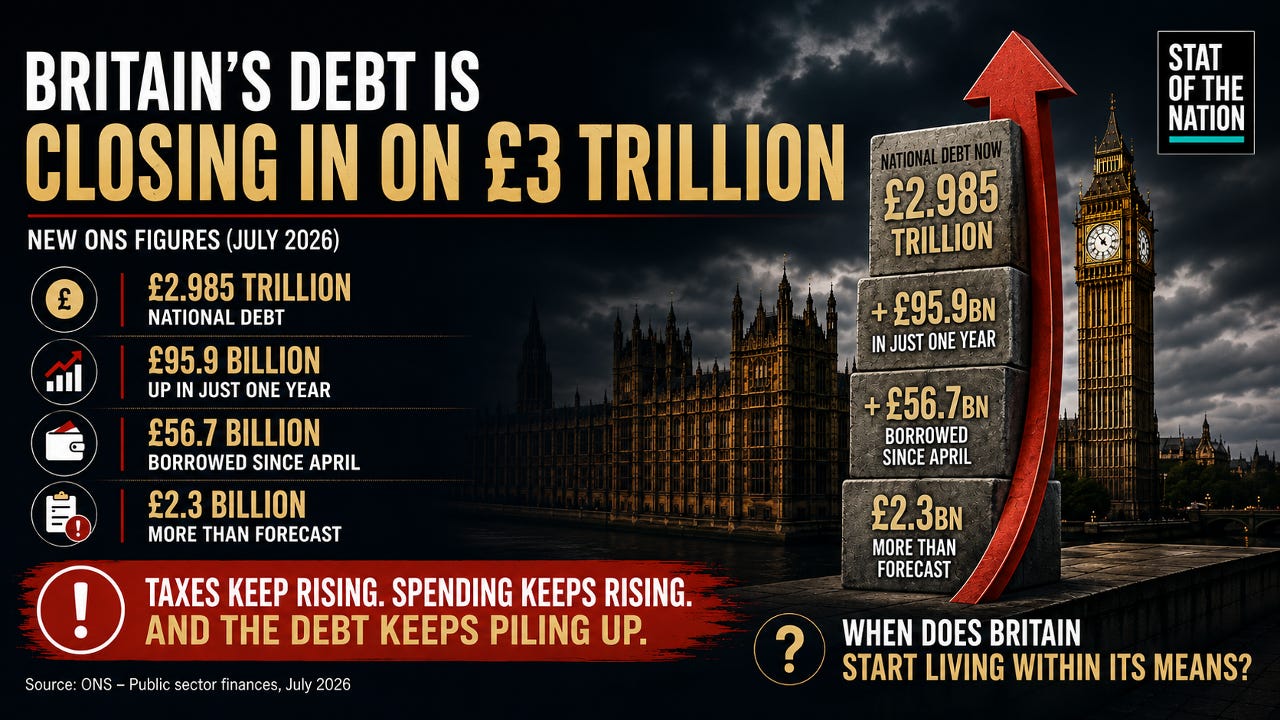
In July alone, public sector borrowing was £1.8 billion. That was £700 million more than in July last year and £2.3 billion above the OBR’s forecast for the month.
So this is not a story of public finances suddenly spiralling in every direction.
It is arguably more concerning than that: even with some improvement in borrowing, Britain is still adding to a debt mountain already approaching £3 trillion.
Taxes Are Rising — But Spending Rose Faster
The most revealing comparison in the latest figures is what happened to government revenue and spending over the past year.
Compared with July 2025, central government tax receipts increased by £4.0 billion to £81.4 billion.
Income-related taxes brought in £38.6 billion, VAT raised £18.5 billion and Corporation Tax contributed £8.9 billion. Overall current central government receipts reached £104.3 billion, around £4.6 billion more than a year earlier.
The Treasury is not suffering from a collapse in revenues.
But spending increased by even more.
Total central government expenditure reached £110.7 billion in July — £5.7 billion higher than a year earlier. Across the wider public sector, Britain still ended the month with another £1.8 billion of net borrowing.
That gives us a pretty simple snapshot of the challenge facing Britain’s public finances:
More tax. More spending. More debt.
Why More Tax Isn’t Enough
One month’s figures cannot tell us everything about the long-term direction of the public finances, but the pressures underneath the July numbers are revealing.
Central government spending on social benefits reached £29.5 billion, £2.0 billion more than a year earlier.
Spending on goods and services reached £39.8 billion, up £1.2 billion, while debt interest rose to £7.7 billion, around £700 million higher than in July 2025.
Overall central government expenditure increased by around 5.4%, while current government receipts increased by around 4.6%.
Yet when Britain’s public finances come under pressure, much of the political debate immediately turns to where government can raise more revenue.
Increase a tax. Freeze a threshold. Raise an employer levy. Find another source of money.
There is a limit to how far that approach can take us.
In July, central government collected £4 billion more in tax than a year earlier, yet its total expenditure increased by £5.7 billion.
Britain cannot keep relying on higher taxation to repair the public finances while spending continues to expand.
At some point, spending has to be part of the conversation too.
That does not mean indiscriminately cutting everything. It means asking much harder questions about what government does, how efficiently public services operate, what taxpayers should reasonably be expected to fund and which commitments the country can genuinely afford.
Those questions become harder the longer they are postponed.
The Debt Interest Trap
One figure deserves particular attention: £7.7 billion of central government debt interest in July alone.
That is money spent servicing borrowing accumulated by governments over many years.
It does not build a hospital, employ another police officer or improve a road.
It pays for yesterday’s borrowing.
And the bigger the debt mountain becomes, the more exposed the public finances are to movements in inflation and borrowing costs.
Britain is particularly exposed through index-linked government debt, where some interest costs move with the Retail Prices Index.
In July, the RPI-linked capital uplift alone added around £1.3 billion to government interest costs.
This is one reason why debt matters even if the Government can comfortably continue selling gilts today. Borrowing creates commitments that future taxpayers have to service, and those commitments compete with everything else government wants to spend money on.
£3 Trillion Is Coming
There is obviously nothing economically magical about the number £3 trillion.
Britain does not suddenly go bankrupt when the debt counter moves from £2.999 trillion to £3.000 trillion.
But psychologically, it should matter.
Three trillion pounds is an extraordinary amount of accumulated debt.
And we should remember how we got here.
Governments of different colours have contributed to Britain’s fiscal position. COVID massively accelerated borrowing, as the state stepped in to support businesses, workers and public services during an unprecedented shutdown.
But the deeper problem predates the pandemic.
Britain has become accustomed to spending more than it raises over long periods.
Those annual deficits accumulate. Eventually they become trillions of pounds of debt, and the interest bill becomes another permanent call on taxpayers.
The latest £95.9 billion increase over just twelve months should be viewed in that wider context.
Cut Spending — Not Just Raise Taxes
There are ultimately only a handful of ways to improve Britain’s public finances.
Raise more tax. Reduce spending. Grow the economy faster. Or combine all three.
Britain desperately needs stronger economic growth. A larger, more productive economy generates more revenue without continually increasing tax rates.
But growth cannot be used as an excuse to avoid making choices about spending.
There also has to be much greater discipline over what government spends, alongside serious work to improve public-sector productivity and get better value from the enormous sums taxpayers already provide.
We cannot simply reach for another tax rise every time the numbers refuse to balance.
Workers and businesses already face an enormous tax burden. Continually asking them for more while allowing expenditure to expand is not a sustainable fiscal strategy.
For years, much of Britain’s political argument has centred on how government can raise more money.
We now need a much more uncomfortable conversation about how much government should spend.
Britain is around £15 billion away from £3 trillion of national debt.
If that isn’t the moment to get serious about public spending, what is?
✍️ Jamie Jenkins
Stats Jamie | Stats, Facts & Opinions
If you found this analysis useful, please share it and subscribe for more.
📲 Follow me here for more daily updates:
Well that could rouine me wishing you a good morning Jamie. 🤦♂️
It's absolutely appalling that governments make us live in a debt-fuelled economy. My husband rolls his eyes at me when I say this. Apparently it's how all governments work and has been for decades. Doesn't make it right though does it? Don't care how other countries are run - we should be aiming to live within our limits. So how about governments simply stop funding things abroad? Stop funding foreigners? Stop paying other countries to do stuff they can't be bothered to do for themselves? I understand we send people off to places like Peru to teach the Indians about transgender rights - why? What's Peru to us or us to Peru? Why do we fund illegal immigrants to float over and live like kings? Actually, why do we fund a King and his relatives when he's as rich as Croesus? Why do we pay people not to work? Why do we fund NGOs and charities? Why do we pay the French anything at all? At some point the whole shebang will collapse around our ears and we'll all be wondering how it happened.