

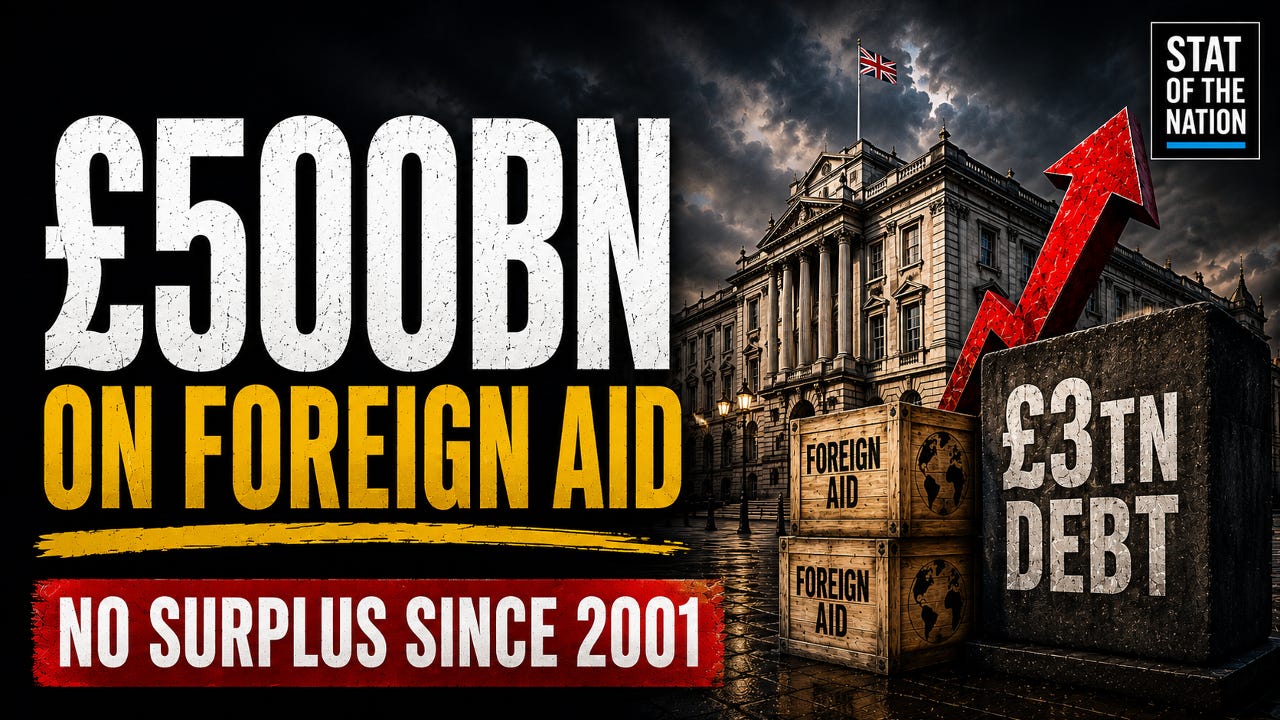
Britain has spent almost half a trillion pounds on foreign aid since 1960, measured in today’s money.
I went back through more than six decades of OECD data to work out exactly how much.
Adding up the money recorded at the time gives a total of around £285 billion. But simply adding pounds spent in 1960 to pounds spent today obviously understates the earlier spending, because money was worth considerably more then.
So I adjusted each year’s expenditure into 2025 prices using the ONS GDP deflator.
That gives a total of around £496 billion — almost half a trillion pounds.
But the most interesting part isn’t the total.
It is when the money was spent.
The Spending Surge After 2000
For roughly four decades, Britain’s inflation-adjusted foreign aid spending was remarkably stable.
In today’s prices:
1960s: ~£40bn
1970s: ~£43bn
1980s: ~£40bn
1990s: ~£41bn
Then something changed.
2000s: ~£82bn
2010s: ~£162bn
2020–2025: ~£89bn already
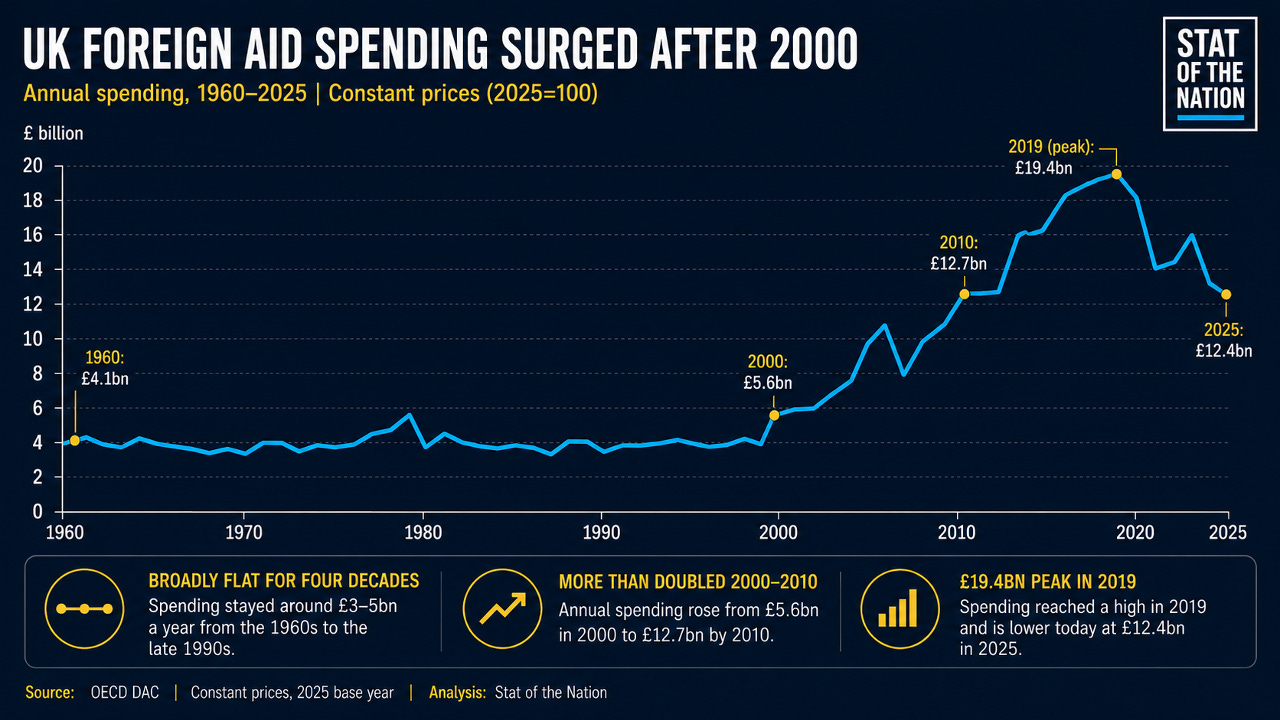
Britain spent around £41bn in today’s money during the whole of the 1990s. That roughly doubled to £82bn in the 2000s, before doubling again to £162bn in the 2010s.
That is not an inflation story. These numbers are already adjusted for changing prices.
In cash terms, annual aid spending went from around £3bn in 2000 to more than £8bn by 2010 and over £15bn by 2019.
So why did it rise so sharply?
A large part of the answer is the political drive towards the 0.7% aid target.
Where Did the 0.7% Target Come From?
The 0.7% figure wasn’t designed around Britain’s public finances.
Its roots go back more than half a century. In 1969, a World Bank-backed commission chaired by former Canadian prime minister Lester Pearson recommended that wealthy countries devote 0.7% of their national income to official development assistance.
The United Nations adopted the target the following year. Britain eventually reached 0.7% in 2013, and the commitment was put into UK law in 2015.
But the underlying principle remained the same: measure aid against the size of the economy rather than whether the Government itself is running a surplus or deficit.
And the world in which that target was created looked very different.
When the UN adopted the target in 1970, Britain was paying roughly £1.3bn a year in government debt interest. Today the annual bill is around £100bn-plus, with recent forecasts putting it at roughly £110bn.
Britain now carries close to £3 trillion of public debt, continues to run substantial deficits and spends around £100bn a year servicing that debt.
Yet the basic aid formula still asks the same question it did more than 50 years ago:
How large is national income?
It does not ask how much Government raises, how much it already spends, how much it needs to borrow or how much is being consumed by debt interest.
That is worth questioning.
Where Does the Money Go?
It is also important to be clear about what “foreign aid” actually means.
In 2025, total UK Official Development Assistance was around £13bn.
That included bilateral programmes, funding for international organisations, humanitarian aid and around £2.4bn spent supporting refugees and asylum seekers inside the UK.
So it is wrong to assume that every pound described as foreign aid is simply transferred overseas.
The latest complete country-level figures, for 2024, showed Ukraine, Afghanistan and Ethiopia among the largest individual recipients. But one of the biggest spending categories was actually “Refugees in Donor Countries”, reflecting eligible expenditure inside Britain.
There are legitimate reasons for overseas spending. Humanitarian aid following wars, famines and natural disasters can save lives. Disease prevention abroad can protect Britain, while development programmes can improve stability and strengthen diplomatic relationships.
This isn’t an argument for Britain turning its back on the world.
It is about what Britain can afford.
Britain Keeps Spending More Than It Raises
Gross National Income tells us about the size of Britain’s economy.
It does not tell us whether Government itself has any money left over.
And Britain usually doesn’t.
The ONS general-government net lending and borrowing series shows the last calendar year in which Government revenue exceeded expenditure was 2001.
Every year since 2002 has recorded a deficit.
Government continues to borrow because the taxes it raises are insufficient to cover everything it chooses to spend. Debt is close to £3 trillion, while around £100bn a year is now being absorbed by debt interest.
Yet historically the aid target has had little connection to that fiscal position.
If national income increased, a fixed percentage of GNI implied a larger aid budget — regardless of whether Government expenditure exceeded revenue by £20bn, £50bn or £100bn.
That seems an odd way to measure affordability.
For context, our inflation-adjusted £496bn historical aid total is equivalent to roughly one-sixth of Britain’s current national debt.
That does not mean foreign aid caused one-sixth of the debt. It is simply a comparison to show the scale of the money involved.
Could Burnham Push Spending Back Up?
Aid spending has already started falling.
UK ODA was approximately:
£15.3bn in 2023
£14.1bn in 2024
£13.0bn in 2025
The current policy is to reduce aid towards 0.3% of GNI by 2027, with savings helping to fund higher defence spending.
But Andy Burnham is already under pressure from Labour MPs to put Britain back on a path towards the previous 0.7% target.
Burnham has not committed to restoring 0.7%, and that distinction matters.
But if the debate does return, the amounts involved are significant.
Using roughly 2025 levels of national income:
0.3% of GNI: around £9bn
0.7% of GNI: around £21bn
That is a difference of approximately £12 billion a year.
Any move back towards 0.7% would therefore have to compete with demands for more money for the NHS, social care, defence, housing and infrastructure — while Government is already borrowing and debt remains close to £3 trillion.
Affordability should surely be part of that conversation.
Are We Using the Wrong Measure?
Imagine two governments.
Both have economies of the same size.
One raises £1 trillion and spends £950bn, leaving a surplus.
The other raises £1 trillion and spends £1.1 trillion, forcing it to borrow £100bn.
A foreign aid target determined solely by GNI could require broadly the same level of aid spending from both, despite their financial positions being completely different.
That gets to the heart of the problem.
When Government already spends more than it raises, every additional permanent commitment ultimately means some combination of more borrowing, higher taxes or less spending elsewhere.
That applies to the NHS, welfare, defence — and foreign aid.
Britain should retain the ability to provide emergency humanitarian assistance, and some overseas programmes clearly advance British strategic interests.
But beyond that, long-term development spending should surely reflect Britain’s fiscal capacity rather than automatically being determined by national income.
That does not necessarily mean linking aid mechanically to whatever surplus happens to appear in one particular year. A more stable rule could look at the underlying fiscal position over several years.
The exact formula can be debated.
The principle is simpler:
Affordability should matter.
The Question We Should Be Asking
Britain has spent around £285bn in recorded cash ODA since 1960.
In today’s money, my calculation puts that at around £496bn.
For decades, inflation-adjusted aid spending was broadly stable. Then it doubled in the 2000s and doubled again in the 2010s.
Meanwhile Britain has not recorded a general-government surplus since 2001. Today we have almost £3 trillion of debt and spend around £100bn a year simply servicing it.
None of that means Britain should stop helping people overseas.
Foreign aid can save lives and some of it can directly advance Britain’s interests.
But it still has to be paid for.
For decades, the argument has been about whether Britain should spend 0.3%, 0.5% or 0.7% of national income.
Perhaps we have been arguing about the wrong percentage.
The real question is whether we have been measuring foreign aid against the wrong number all along.
✍️ Jamie Jenkins
Stats Jamie | Stats, Facts & Opinions
If you found this analysis useful, please share it and subscribe for more.
📲 Follow me here for more daily updates:
The government spends my money (my taxes) and my grandchildren's money (debt they are saddled with repaying). At no point do politicians behave as though they have any duty toward the money they take from me and my descendants.
We do want to help other countries when disasters like famines and floods occur, but we do not want to pay for dance lessons in Ethiopia. Our contribution should be proportionate to what we can afford. In good times we might fund a programme about how to use a condom in Pakistan, but not when we have homeless veterans here.
There is a moral dimension to aid. It is just that we who pay for all this are excluded from consideration. Some of us find that immoral.
I watched an interview with Caroline Lucas of the Greens. This was about having open borders. She said "Britain is the 6th richest country in the world and therefore we can afford to support the immigrants". But it doesn't feel like we are the 6th richest. It feels like we are poor and getting poorer. We seem to be short of money for almost everything.