

Britain’s adult male prisons are operating at 98% capacity. The consequence is not simply overcrowded jails; sentencing policy is being rewritten around the number of cells available.
From October, some eligible prisoners currently released after 40% or 50% of their sentence could become eligible after one third. Someone handed a three-year standard determinate sentence could therefore have an earliest release point of around one year, with the remainder served under supervision in the community.
Rapists, serious child-sex offenders and grooming offenders have now been excluded. More than 18,000 prisoners serving the most serious sentences, including life and Extended Determinate Sentences, will also remain under the existing arrangements.
That is right, but it does not answer the bigger question: why did Britain allow its prisons to become so full that thousands of other prisoners must leave earlier at all?
This is not justice designed around the sentence. It is sentencing designed around the number of available cells.
Sentences Are Being Changed to Fit the Space
The Government says its new progression model will reward good behaviour. Prisoners who break the rules or behave violently could be held for longer, potentially for their entire sentence.
But the starting point still matters. Some prisoners currently released at 40% or 50% could become eligible after one third, while some currently released after two thirds could become eligible after one half.
The Prime Minister has admitted that he wanted to exclude more offenders but could not do so without risking the prison system “reaching capacity and collapsing”. The Government’s own announcement says more than a decade of inadequate investment has left adult male prisons at 98% capacity.
That is the central issue. Ministers are not principally arguing that every affected offender no longer needs to be in prison; they are saying there is insufficient space to keep them there for as long.
Court sentences should determine the prison capacity Britain needs. Prison capacity should not determine how much of a court sentence is served behind bars.
The Prison Estate Is Filling with Longer Sentences
There were 85,858 prisoners in England and Wales on 30 June 2026, including 70,003 sentenced prisoners. Around seven in ten people serving immediate custodial sentences had been convicted of violence, sexual offences or drug offences.
Compared with June 2025, the number serving sentences of between two and five years rose by around 10%, while those serving five to seven years increased by 7%. At the other end of the scale, the number serving less than six months fell by 22%, with those serving six to 12 months down 16%.
Some of this is straightforward arithmetic. Prisoners serving longer terms remain in the estate for years and accumulate, while people serving only a few months pass through much more quickly.
But the fall in short-sentence prisoners does not necessarily mean fewer lower-level offenders. In some cases, it means people who might previously have gone directly to prison are instead receiving suspended sentences or punishment in the community.
The Sentencing Act creates a presumption that custodial sentences of 12 months or less should be suspended, subject to exceptions including significant risk of harm, breaches of court orders and exceptional circumstances.
Britain is therefore changing the prison population from both directions: releasing some prisoners sooner while sending fewer short-sentence offenders to prison in the first place.
Ministers may argue that tougher community sentences are more effective for some offenders. But the shortage of prison space is plainly helping to determine who enters prison, as well as when others leave.
The Capacity Failure Happened Years Ago
The Government is now building more prison places, and it would be wrong to suggest otherwise. It says 2,900 places have been delivered since July 2024, more than 5,000 are under construction and 14,000 additional places are planned by 2031.
That investment is necessary and overdue. It does not alter the fact that sufficient capacity should have existed before prisons reached 98% occupancy and release rules had to be changed.
The Government says only 500 net places were added to the prison estate over the previous 14 years. New prisons and cells were built, but closures, maintenance and capacity lost elsewhere meant the overall increase was nowhere near enough.
This explains how thousands of new “places” can be announced while the estate remains almost full. Gross construction is not the same as the net increase in usable capacity, and rising prisoner numbers can absorb new places almost as soon as they open.
Britain has not built nothing. It failed over many years to add enough net, usable capacity to create meaningful breathing room.
The current building programme is welcome, but those cells are arriving after the shortage has already forced changes to sentencing.
One Prison Category Has Nearly Doubled
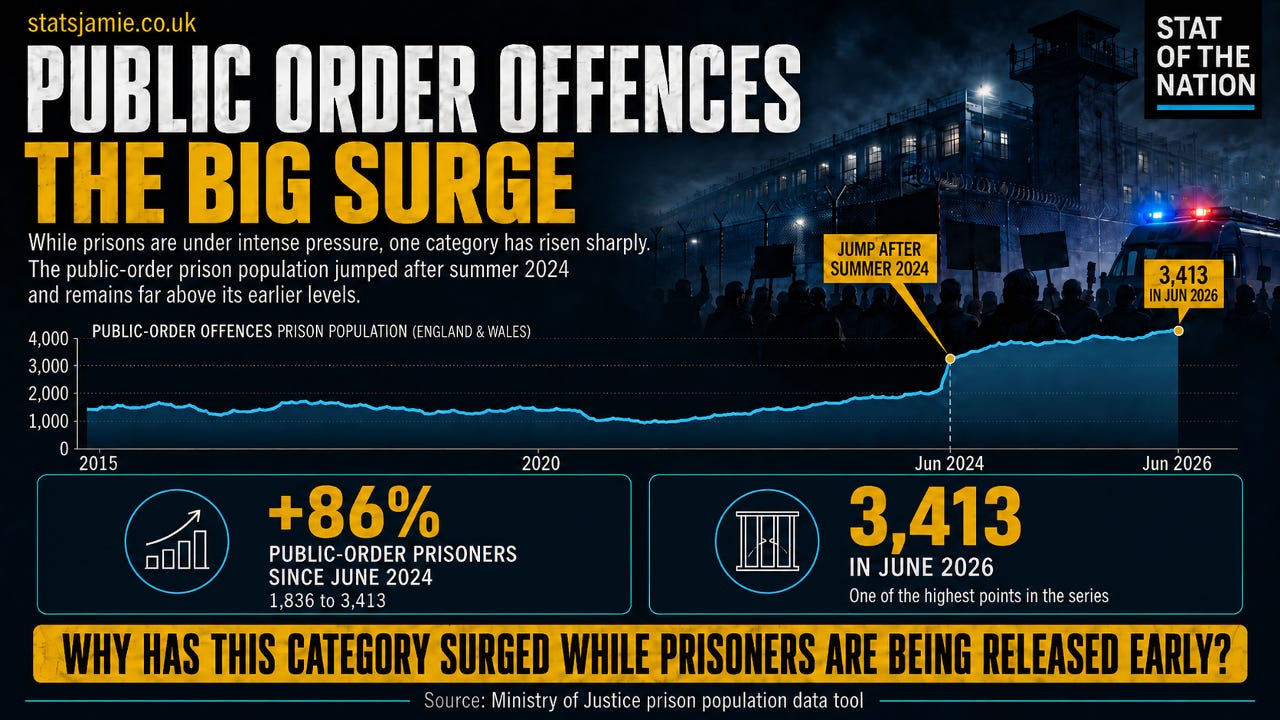
At a time when prisons are 98% full and ministers say other offenders must be released earlier, one category of the sentenced population has risen particularly sharply.
The number serving immediate custodial sentences for public-order offences was 86% higher in June 2026 than in June 2024. The Ministry of Justice says this is likely to reflect the disorder during summer 2024, but public order covers a wide range of conduct.
Some prisoners may have committed serious violence, made threats or caused criminal damage. Others may have been convicted over protest, speech or material published online, which is why the figures do not allow us to assume that every additional prisoner was a violent rioter.
Cases such as Lucy Connolly’s show why the conduct behind each sentence matters. When prison space is this scarce, it is reasonable to ask whether every public-order case resulting in custody represented the best use of a limited cell.
That leaves a legitimate question: why has the state nearly doubled the number imprisoned from this broad offence category at the same time it says prisoners elsewhere must be released early because there are not enough places?
If dangerous offenders committed violence, prison may be entirely justified. But where cases involved speech, protest or online material rather than physical harm, the use of scarce prison capacity deserves far greater scrutiny.
One arm of the justice system increased the number imprisoned from this category. Another brought forward the release of existing prisoners to make room.
The state should explain clearly why these offences have resulted in such a sharp increase in imprisonment while other offenders are being released early.
Early Release Moves the Pressure Elsewhere
Releasing prisoners does not remove the risk or workload. It transfers more responsibility to probation, electronic monitoring and recall enforcement.
There were 13,193 licence recalls between January and March 2026, an increase of 31% compared with the same quarter a year earlier. The Ministry of Justice says early-release schemes increased the number of people on licence and therefore the opportunities for recall.
Not every recall means another offence has been committed. People can be returned to prison for breaching licence conditions, including failing to remain in contact or breaking residence requirements.
But the consequences when release goes badly wrong can be devastating. Liam Matthews was released from HMP Holme House in September 2024 and later that day took part in the fatal attack on 26-year-old Lewis Bell. He was subsequently convicted of manslaughter and sentenced to 15 years, followed by three years on extended licence.
One horrific case cannot describe the behaviour of every prisoner released early. It does, however, show why releasing prisoners to create space cannot be treated as a purely administrative exercise; for Lewis Bell and his family, the consequences were permanent.
Foreign Offenders Must Be Removed Where Possible
There were 10,134 foreign nationals in custody on 30 June 2026, including 6,431 sentenced prisoners, 3,283 people held on remand and 420 non-criminal prisoners.
Those groups must not be confused. Someone held on remand has not necessarily been convicted, and not every sentenced foreign national can lawfully or practically be removed.
However, where deportation or transfer abroad is lawful, it should happen quickly. Every avoidable delay occupies a cell that could be needed elsewhere.
The Government says it wants foreign offenders removed faster and in greater numbers. That must become a practical part of relieving pressure on the estate, rather than another review that produces little action.
Build the Cells — And Be Honest About the Policy
The Government is right to accelerate prison construction, but building now does not erase the failure that allowed the estate to reach this point.
Adult male prisons are 98% full. Some prisoners could become eligible for release after one third of their sentence, fewer short custodial sentences will result in immediate imprisonment, and more punishment and risk management will move into the community.
The Government describes this as a sustainable sentencing model. In reality, it has been designed under the immediate constraint of insufficient prison capacity.
Had Britain built enough usable places over the previous decade, ministers would have had far more freedom to decide sentencing policy on its merits. Instead, the Prime Minister has admitted that excluding more offenders could cause the prison system to collapse.
Britain did not fail because no prisons were built. It failed because nowhere near enough capacity was created before the crisis arrived.
Early release creates an empty cell today, but it does not create the prison capacity Britain needs tomorrow.
✍️ Jamie Jenkins
Stats Jamie | Stats, Facts & Opinions
If you found this analysis useful, please share it and subscribe for more.
📚 You might also want to read:
Britain Is Losing Wealth, And Everyone Will Pay

Britain now has fewer real-terms millionaires than at any point since 2008.
📲 Follow me here for more daily updates:
Prison population has increased by a factor of ten since just before the war. Even allowing for the general population roughly doubling since then we still have five times more in prison now than we did then. This seems strange since in 1940 you could go to prison for stealing a loaf of bread and now shoplifting is hardly counted as a crime at all.
The entire judicial system has suffered years of underfunding, first by the Tories and since them by Labour. Under Burnham, this will no doubt continue, as it will too in all other essential areas of public life. The country needs more money in it and those in charge of providing it, ie the Govt. who control the money supply, refuse to do so on transparently implausible grounds. Until that situation changes, quality of life for the majority in the UK will continue to deteriorate.