

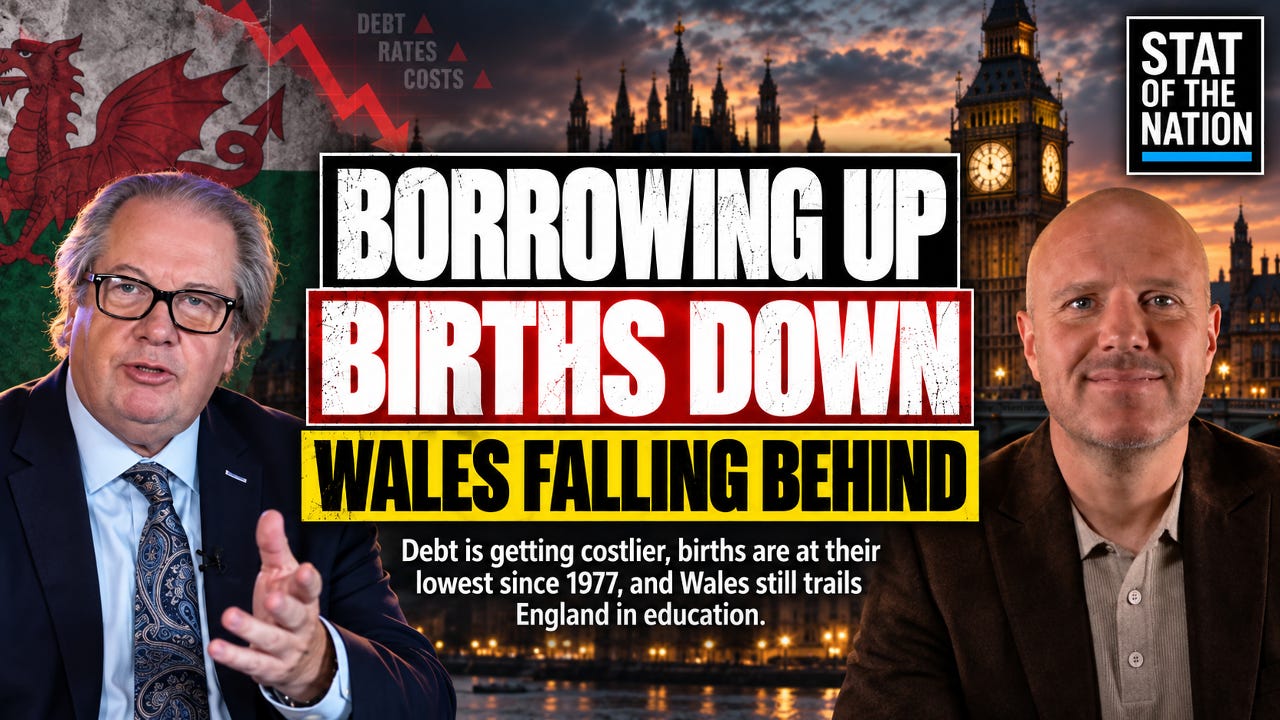
There was plenty to discuss in my latest weekly conversation with Mike Graham on The Mike Graham Show .
Britain is borrowing at increasingly expensive rates. Births in England and Wales have fallen to their lowest level since 1977. And in Wales, the latest education figures raise yet more questions about what more than a quarter of a century of devolution has delivered.
Here’s our full conversation.
Britain’s Borrowing Costs Are Rising
The Government sold £4.25 billion of 30-year debt this week at a yield of around 5.8% — the highest yield on a syndicated gilt since the Debt Management Office was established in 1998.
There are global pressures pushing bond yields higher, so this is not simply a British problem. But the principle is straightforward: the more expensive it becomes for government to borrow, the more taxpayers ultimately spend servicing the debt.
When the national debt is already approaching £3 trillion, that matters.
Britain’s Baby Bust
Births in England and Wales have fallen to their lowest level since 1977, while the fertility rate has dropped to just 1.39 children per woman.
There are many reasons people are having fewer children, but housing and affordability are difficult to ignore.
Almost three in ten people aged 20 to 34 now live with their parents. House prices have become far less affordable relative to earnings, rents are expensive and family formation is increasingly being pushed later.
It is hardly surprising that people delay having children when getting a home of their own has become so difficult.

Housing, Immigration and Population
That brought us onto immigration and population growth.
More people means more demand for homes, roads, schools and public services. If the supply of that infrastructure does not keep pace with population growth, the pressure does not disappear — it shows up in prices, rents and stretched services.
We also discussed another striking demographic statistic: around 40% of births in England and Wales now involve at least one parent who was born outside the UK.
That is an important part of understanding how Britain’s population is changing — and the scale of the infrastructure challenge facing governments.
Wales Is Still Falling Behind
Finally, we returned to education in Wales.
Education has been devolved since 1999, giving Wales the freedom to make different choices from England on assessment, qualifications, accountability and the curriculum.
After more than 25 years, those policies can reasonably be judged on their results.
And the uncomfortable fact remains: Wales performs below England in the major international education assessments, and the gap has widened.
Devolution was supposed to allow Wales to do things differently.
The question is whether different has meant better.

The Bigger Picture
These are very different statistics, but they point towards some of the same underlying pressures.
Britain is borrowing at increasingly expensive rates. Younger generations are finding housing less affordable and having fewer children. Population growth continues to increase demand for homes and infrastructure. And in Wales, more than 25 years of devolved education have not delivered better outcomes than England.
None of these trends appeared overnight.
The question is whether politicians are prepared to confront the numbers — rather than simply manage the consequences.
✍️ Jamie Jenkins
Stats Jamie | Stats, Facts & Opinions
If you found this analysis useful, please share it and subscribe for more.
📲 Follow me here for more daily updates: