

The beginning of a new financial year should have offered Britain a fresh economic start.
Instead, gross domestic product fell by 0.1% in April 2026. Services contracted by 0.2%, production was flat and construction managed growth of just 0.1%.
One weak month does not mean Britain is in recession. Monthly GDP is volatile, several industries continued to grow and the wider three-month trend remains positive.
But April matters because several warning signs arrived together.
The new tax year began with income-tax thresholds still frozen. Employers faced another substantial rise in statutory wage rates. Consumer-facing activity weakened. Payroll employment continued to fall. More than one million young people were outside education, employment or training. Government borrowing began the year above forecast.
Then the conflict involving Iran pushed up energy and fuel costs.
That international shock helps explain why the economy stumbled. It does not explain why Britain was so poorly prepared to absorb it.
The Economy Went Backwards In April
Services represent around four-fifths of the UK economy, so a 0.2% fall was enough to pull overall GDP into negative territory.
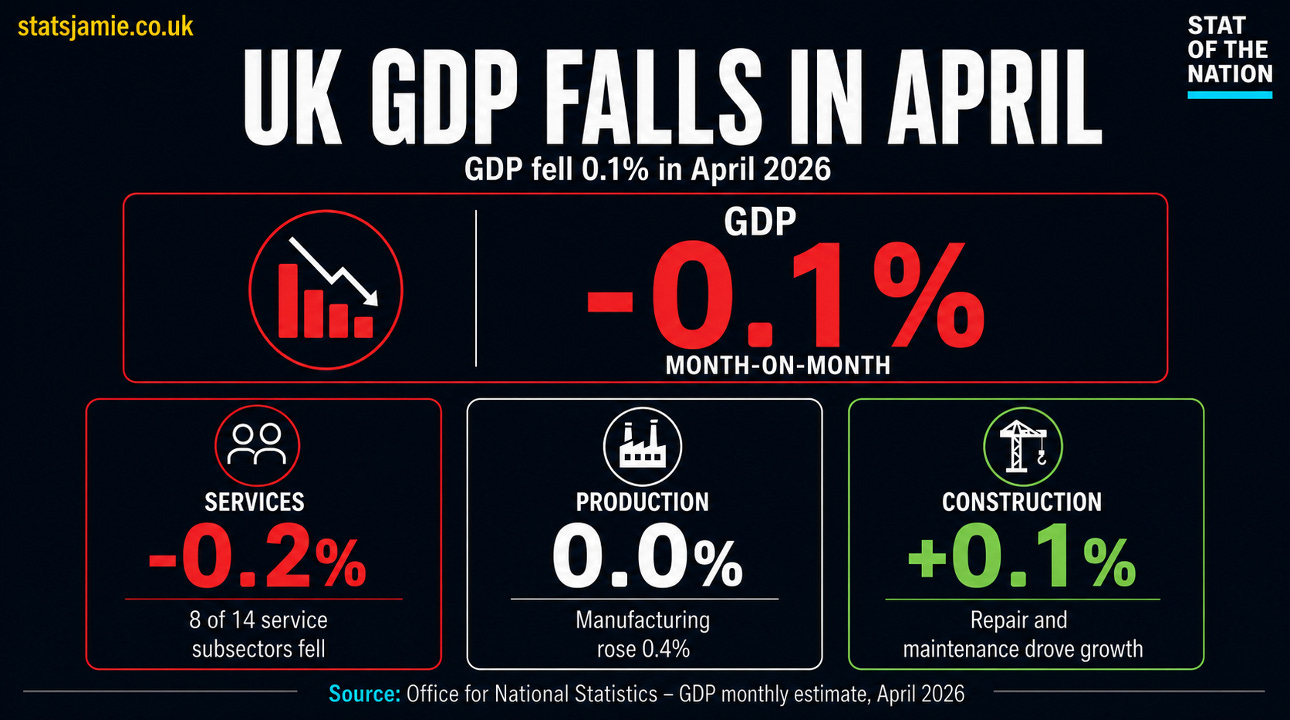
Eight of the 14 service subsectors contracted. Among the most notable falls were:
Administrative and support services: down 2.2%
Arts, entertainment and recreation: down 4.3%
Retail trade: down 1.3%
Employment activities: down 2.6%
Consumer-facing services as a whole fell by 0.5%.
There were genuine areas of strength. Information and communication grew by 1.1%, manufacturing increased by 0.4% and pharmaceutical manufacturing rose by 4.2%.
Construction also remained marginally positive, although its recent improvement has been driven more by repair and maintenance than by a substantial increase in new building.
This is not an economy in freefall. It is an economy in which growth remains narrow, with technology and pharmaceuticals performing relatively well while retail, employment activity and household-facing sectors struggle.
Iran Was A Real Shock — But Not The Whole Explanation
It would be wrong to discuss April without recognising events overseas.
The Office for National Statistics reported that the Middle East conflict affected businesses in manufacturing, wholesale, transportation, accommodation and travel.
UK-based companies also lost activity following the cancellation of sporting events in the region. Output from sports activities, amusement and recreation fell by 9.1%, making it the largest individual drag on GDP during April.
Businesses reported additional pressure from energy and fuel costs. Forty per cent of trading businesses said the prices of goods they purchased had increased during April, the highest proportion since December 2022.
These effects are real. Britain imports energy and operates within global supply chains, so conflict involving Iran and pressure on oil markets will inevitably affect costs and confidence.
But external shocks reveal the resilience of an economy. Britain entered this one with taxation close to historic highs, borrowing elevated, hiring weakening and household finances already under strain.
The conflict did not create those structural weaknesses. It exposed them.
A New Tax Year Without A Tax Reset
April marked the beginning of the 2026/27 tax year.
The government introduced some measures that should help households, including support intended to reduce energy bills, a freeze in regulated rail fares in England and an extension of the temporary 5p reduction in fuel duty.
Those measures provide genuine relief and should be acknowledged.
But the new tax year did not produce a meaningful reset for taxpayers.
The personal allowance remains frozen at £12,570. As wages rise, more income is brought into taxation and more workers are pulled towards higher tax bands.
The government does not need to announce a higher income-tax rate for the tax burden to increase. Inflation and wage growth do the work automatically.
Dividend tax rates also increased, adding to the burden on company owners, entrepreneurs and investors who receive part of their income through dividends. Business rates were reset following revaluation, with transitional support protecting some firms but higher liabilities falling on others.
None of these measures alone explains a monthly GDP movement of 0.1%.
Together, however, they reveal the contradiction at the heart of the government’s approach: ministers say growth is their central mission while continuing to remove spending power from households and increase the costs faced by employers and investors.
Britain already has one of the highest tax burdens in its modern history. That means every additional rise matters.
Households have less money available to spend. Businesses have less room to invest. Employers become more cautious about recruitment. The productive economy is expected to carry more of the state while generating the growth needed to pay for it.
That is not a sustainable model.
Even Labour Ministers Have Questioned The Strategy
The most revealing criticism of Labour’s growth agenda has not come from the opposition.
It has come from inside government.
In private messages to Peter Mandelson, Wes Streeting wrote:
“No growth strategy at all.”
That does not mean the government has no individual growth policies. Ministers can point to planning reform, infrastructure proposals, investment initiatives and measures intended to improve economic stability.
But the comment matters because it came from a senior Cabinet minister. It suggests that concerns about the absence of a coherent strategy were also being expressed privately at the top of government.
Another message, this time from Pat McFadden, was even more revealing.
Discussing pressure from Labour MPs over welfare policy, he wrote:
“Every meeting I have is ‘who can we tax in order to pay benefits to others’. They’re asking the wrong questions.”
One private message should not be presented as the settled view of every Labour politician. But McFadden’s frustration points towards a deeper problem.
Too much political debate begins with the cost of government promises and asks who can be taxed to pay for them.
The better questions are how more people can become economically independent, how businesses can create more productive work, and how the private economy can generate the resources required to fund essential services.
Taxation can redistribute existing income. It does not automatically create new wealth.
A strong welfare state depends on a strong productive economy beneath it. Without growth, government is left dividing an inadequate economic pie while borrowing to cover the gaps.
Higher Wages — But At What Cost?
The National Living Wage increased from £12.21 to £12.71 an hour in April, a rise of 4.1% for workers aged 21 and over.
Younger workers received larger increases:
Ages 18 to 20: up 8.5%, to £10.85
Ages 16 to 17: up 6.0%, to £8.00
Apprentice rate: up 6.0%, to £8.00
These rises were above consumer-price inflation.
For workers who retain their jobs and hours, that represents a real improvement in hourly pay.
But the employer’s cost is not measured by CPI alone. Businesses must absorb higher wages alongside employer National Insurance, pensions, rent, energy, business rates and other operating costs.
The additional cost has to appear somewhere:
Lower profits
Higher prices
Fewer hours
Reduced recruitment
Automation
Job losses
The effect is not evenly distributed. A profitable technology company may absorb the increase relatively easily. A pub, café, hotel, care provider or high-street shop operating on narrow margins may not.
It would be simplistic to blame every lost retail or hospitality job on the minimum wage. Weak demand, energy costs, rents and payroll taxes also matter.
But it is equally unrealistic to claim that repeatedly increasing the price of employing people has no effect on hiring.
For some workers, the policy means higher pay. For some potential workers, particularly those with little experience, it can mean the job is never created.
The Jobs Market Is Flashing Warning Signs
The unemployment rate stood at 5.0%, up by 0.5 percentage points over the year.
Vacancies fell to 705,000, the lowest level since early 2021. Payroll employment also weakened, while the provisional April estimate pointed towards another sizeable fall.
That early payroll figure should be treated cautiously because estimates around the start of a tax year can be revised substantially.
But the broader direction is difficult to dismiss:
Vacancies are falling
Unemployment is higher
Payroll employment has weakened
Private-sector wage growth has slowed
Employment-related business activity fell in April
Businesses hire when they expect demand and revenue to grow.
When they face weaker sales alongside higher wages, National Insurance, business rates, energy costs and regulation, they become more cautious.
That caution often appears first in recruitment. Vacancies disappear before established employees are dismissed, and entry-level jobs are among the easiest positions to leave unfilled.
That is particularly damaging for the young.
Britain Is Locking Young People Out Of Work
More than one million people aged 16 to 24 were not in employment, education or training during the first quarter of 2026.
The total reached 1,012,000, equivalent to 13.5% of the age group and 89,000 more than a year earlier.
Of those young people:
400,000 were unemployed and actively seeking work
613,000 were economically inactive
The figures need careful interpretation. Many young people remain in full-time education and youth labour-market measures can be volatile.

But the scale and direction are deeply concerning.
Britain has built an education system that encourages young people to collect qualifications, often with significant debt attached, without creating a reliable route into work.
The first rung of the ladder is disappearing.
Retail, hospitality, leisure and customer services have traditionally provided young people with their first experience of employment. These are also among the sectors most exposed to rising wage costs, employer taxes, business rates, energy bills and weak consumer demand.
Government cannot claim to be concerned about youth worklessness while making entry-level employment steadily more expensive.
Government should also reduce the cost of hiring young people. Employers already receive National Insurance relief for workers under 21, but that support could be extended through a tapered system up to age 25, particularly where jobs include accredited training or apprenticeships. The principle is simple: make it cheaper for employers to take a chance on someone with little experience, rather than leaving young people outside work for years.
Borrowing Rules Out Easy Answers
The government cannot solve every problem by announcing another spending programme.
Public-sector borrowing reached £24.3 billion in April, £4.9 billion more than a year earlier, £3.4 billion above the Office for Budget Responsibility forecast and the highest April figure since 2020.
There was some better news across the previous financial year. Borrowing in the year ending March 2026 came in below both the previous year and the OBR forecast.
That deserves recognition.
But beginning the new financial year above forecast shows how little room exists for error.

High borrowing creates its own growth problem. More debt means more interest, leaving less money for infrastructure, public services or tax reductions. Inflation can raise the cost of index-linked debt, while weak growth reduces the revenues needed to stabilise the position.
That is why lower taxes must be credible.
Borrowing money to finance temporary tax cuts would risk higher interest costs and leave taxpayers with a larger bill later. The objective should be to reform and restrain spending sufficiently to allow workers and businesses to keep more of what they earn.
Energy Must Be Central To The Growth Plan
Energy cannot remain a side issue in Britain’s economic strategy.
Households and businesses face some of the highest energy costs in the developed world. That weakens consumer spending, raises production costs and makes British firms less competitive.
Every pound spent unnecessarily on electricity, heating or fuel is a pound that cannot be spent elsewhere.
For households, lower energy bills would operate much like a tax cut.
Families would have more money left to spend in shops, restaurants and local services. That would support demand across the economy without requiring another government spending programme.
For businesses, cheaper and more reliable energy would reduce costs, improve margins and create more room for investment, recruitment and lower prices.
Energy costs feed into almost everything: food production, transport, manufacturing, hospitality, retail, construction and public services.
In a country where taxes are already historically high, government cannot keep removing spending power through taxation while allowing essential energy costs to absorb more of what remains.
Short-term subsidies may soften the impact of a crisis, but they do not fix the underlying problem.
Britain needs a coherent long-term strategy built around reliable domestic supply, secure infrastructure, investment in the grid and lower prices.
That means being pragmatic about the energy mix, reducing dependence on volatile imports and judging policy by whether it delivers affordable and secure energy rather than by political slogans.
A credible growth strategy must recognise that cheaper energy is not merely an environmental or industrial policy.
It is an economic policy, a competitiveness policy and, in effect, a tax cut for every household and business.
A Credible Route Back To Growth
The government is right that stability matters.
Planning reform could eventually increase housing and infrastructure. Support with energy and transport costs helps household budgets. Higher statutory wages increase the incomes of workers who remain employed.
A balanced assessment should acknowledge all of that.
But stability is not the same as growth.
Growth comes when businesses invest, workers become more productive and households have the confidence and disposable income to spend.
Britain needs a serious programme built around those fundamentals:
Gradually unfreeze income-tax thresholds
Reduce the tax burden on employment
Extend targeted employer National Insurance relief for younger workers
Simplify business rates and reduce the penalty on physical premises
Reward investment rather than continually finding new ways to tax it
Accelerate planning, housing and infrastructure decisions
Reform welfare around capability, rehabilitation and routes into work
Improve technical education and connect it directly to employers
Deliver cheaper, reliable domestic energy through a coherent long-term strategy
Control day-to-day government spending
Lower taxes are not a magic wand. If financed through uncontrolled borrowing, they can create another problem. If businesses lack skilled workers, infrastructure or reliable energy, tax reductions alone will not deliver prosperity.
But the current balance has moved too far towards government extraction.
Households cannot drive consumption when increasing shares of their income are absorbed by tax, housing, utilities and debt. Businesses cannot expand confidently when every financial statement threatens another cost. Young people cannot gain experience when employers conclude that taking a chance on them is too expensive.
Britain needs stronger demand and greater productive capacity.
That means leaving people with more money to spend while removing the barriers that prevent businesses from investing, employing and building.
Labour Is Asking Who To Tax — Britain Must Ask How To Grow
April’s contraction may prove temporary.
The monthly numbers are volatile. The wider three-month trend remains positive. The conflict involving Iran had identifiable effects on energy, fuel, travel, supply chains and sporting activity.
It would be unfair to blame Rachel Reeves for every part of the monthly fall.
But governments are judged not only by the shocks they face. They are judged by the resilience they build before those shocks arrive and by the response they offer afterwards.
Britain began the new tax year with frozen tax thresholds, elevated borrowing, falling vacancies, weaker payroll employment and more than one million young people outside employment, education or training.
Against that background, the private comments attributed to two senior Labour ministers are significant.
Wes Streeting said there was “no growth strategy at all.”
Pat McFadden complained that meetings focused on who could be taxed to pay benefits rather than how people could be helped into opportunity.
Those messages identify the central problem more clearly than another Treasury slogan ever could.
Britain cannot tax and redistribute its way to prosperity.
It needs more people working, more businesses investing, more homes and infrastructure being built, cheaper and more secure energy, and households with enough money left to spend.
The defining question should not be:
Who can we tax next?
It should be:
What must change so Britain can grow again?
✍️ Jamie Jenkins
Stats Jamie | Stats, Facts & Opinions
📢 Call to Action
If this helped cut through the noise, share it and subscribe free by entering your email in the box below and get the stats before the spin, straight to your inbox (no algorithms).
📲 Follow me here for more daily updates: