

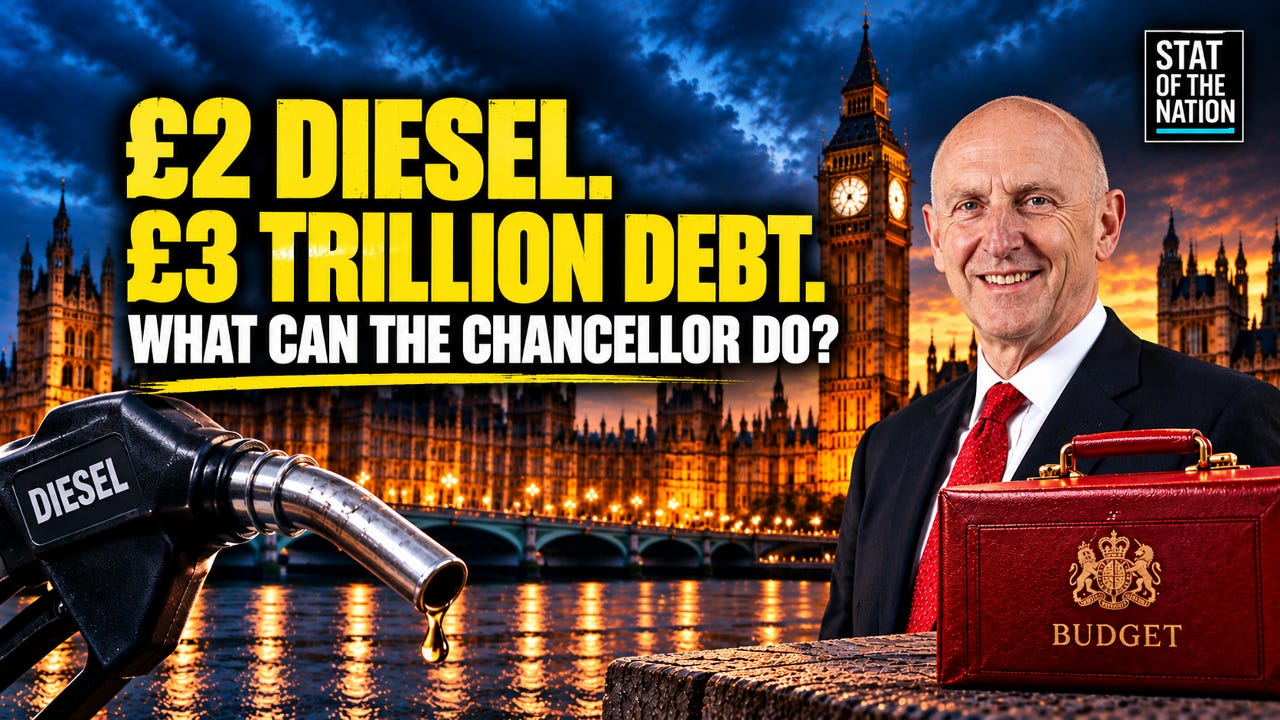
Diesel has reached £2 a litre, government debt is approaching £3 trillion, and the Chancellor faces another difficult Budget.
But here’s a statistic you might not have considered. As diesel prices have increased since February, the VAT included in every litre has risen by almost 10p.
I joined Nana Akua on GB News this weekend to discuss Britain’s cost-of-living squeeze, the growing pressures on the public finances and what John Healey could do in his first Budget on 28 October.
Watch our full discussion below.
Inflation Is Hitting Households and the Treasury
The war in Iran has added another complication to Britain’s economic problems, with higher oil and gas prices feeding through into household bills and business costs.
The latest ONS figures show CPI inflation at 3.1% in August, while Ofgem’s energy price cap increased by 4% in October for a typical household on a variable tariff.
But inflation doesn’t just hit households. It also increases the cost of servicing Britain’s inflation-linked government debt, feeds into future benefit uprating and raises the cost of delivering public services.
And the public finances are already stretched.
Government debt stood at £2.99 trillion at the end of August, while borrowing in the first five months of the financial year reached £77.3 billion, some £8.1 billion above forecast, although £2.2 billion lower than the same period last year.
That’s the difficult backdrop facing the Chancellor.
Diesel at £2 a Litre: The Treasury Collects More VAT
One statistic I highlighted during the interview deserves particular attention.
According to the government’s weekly road fuel statistics, average diesel prices have increased substantially:
23 February 2026: 141.46p per litre
12 October 2026: 200.04p per litre
Increase: 58.58p per litre
Because VAT is charged at 20%, the amount of VAT included in each litre has increased by approximately 9.8p.
So while motorists are paying almost 59p more for every litre, the Treasury is collecting nearly 10p more in VAT per litre sold.
That doesn’t necessarily mean overall VAT receipts have increased, as higher prices can discourage consumption.
But it raises a reasonable question.
Should the Chancellor give motorists some relief by reducing fuel duty rather than simply continuing to freeze it?
Any reduction would need funding, but the pressure on motorists and businesses is undeniable.
What Should the Chancellor Do?
My argument during the interview was straightforward. Britain cannot keep relying on higher taxation and borrowing to fund ever-growing spending commitments.
We need an economy that encourages businesses to invest, recruit and grow.
The latest ONS figures show 981,000 young people aged 16–24 are not in employment, education or training. Not all are claiming benefits, but improving opportunities for this group should be an important economic priority.
The Chancellor could look at reducing employment costs, providing targeted relief on fuel and energy, and reforming public spending to deliver better value for taxpayers.
Of course, tax cuts and additional support have costs of their own. There are no easy answers when borrowing remains high.
But the underlying challenge is bigger than one Budget.
Britain is approaching £3 trillion of debt, the tax burden is heading towards record levels, and inflation is adding further pressure to household and government finances.
How does Britain get back to sustainable public finances without continually asking taxpayers to pay more?
That’s the question John Healey needs to answer.
Thanks for reading Stat of the Nation. I break down the statistics behind the headlines, cutting through the political spin to explain what’s really happening across Britain.
If you value independent, evidence-based analysis, please share this article and subscribe for more statistics behind the headlines.
✍️ Jamie Jenkins
Stats Jamie | Stats, Facts & Opinions
📲 Follow me here for more daily updates:
Jamie, your correct to highlight the government stupidity in borrowing more when the economy doesn’t have to sustain this debt.
The general view that governments can only raise government income from increasing taxation rates is stupidity itself.
Your own point that the increase in fuel prices brings in more vat is an excellent example to teach them that increasing turnover (in your case by increasing prices) acts the same way when you increase SPENDING in general!!!!!!
The point you raised was a back handed result of higher prices is resulting in higher vat take.
But as I’ve been trying to point out for months Jamie, is it also works naturally when we increase SPENDING!
And to increase SPENDING to raise vast sums of vat is just by SPENDING the money that sits idle in bank accounts at home and abroad. That could be positively affecting the take of government tax income with exponential flow of money into the economy just from SPENDING it!
You have seen the bad affect if rising prices. But you have to also see the benefit it would be by increased SPENDING could do by vastly increasing vat income!
Jamie….think of this….
If you google total sterling money in existence in uk you eventually get a figure of £19 trillion pounds. …. Now I have no idea if that is correct. But we do know coin and paper are a lot less. So the rest must be digital money and as we owe £4 trillion pounds then a total of £19 trillion sounds plausible. But if we accept that whatever the total is it surely has to be a total that should cover population and need then that figure sounds reasonable. So let’s use it for the sake of argument. My principles stay the same anyway.
If we were to SPEND all if that amount in just one rotation do spend it just the once, not millions of times a day but just once in one whole year then the vat take from that amount could well be £3,8 trillion pounds in vat alone!
As you know Jamie our government tax take now is something like £1.2 trillion from all taxation while our government spends about £1.5 trillion each year now!
So you can see Jamie, the power of spending!
When we spend we automatically clock up vat and we could be clocking up such vast sums of vat just from spending than we do now from all taxation why isn’t it our government policy to ensure money is spent??
When we spend money freely we not only pass money in to others to get paid for their work we also receive goods to that value! So we all get stuff we need now. In fair swap.
But crucially that turbo charged economy creates so much vat our government should not have to borrow anything!
Can you not see that Jamie?