

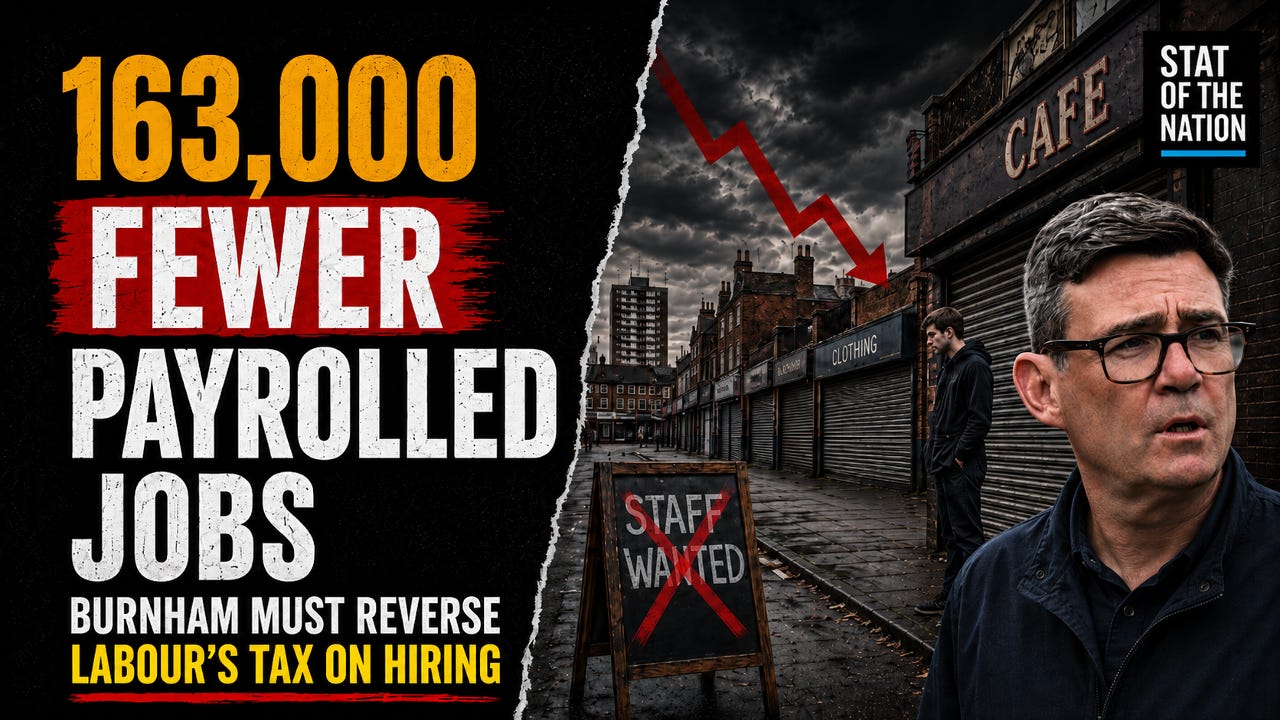
Britain is not simply losing jobs. It is losing the jobs that give young people their first chance to work.
A new business survey suggests private-sector firms have reduced staffing for 22 consecutive months, matching the longest sustained downturn recorded during the financial crisis.
Official figures from the Office for National Statistics point in the same direction.
Payrolled employment has fallen from around 30.45 million in June 2024 to 30.28 million in June 2026, approximately 163,000 fewer employees than in the month before Labour entered government.
Labour did not create every weakness in the jobs market. Employment growth was already slowing before the election.
But it inherited a cooling labour market and then increased the cost of employing people.
That was the wrong policy at the wrong time.
Andy Burnham now has an opportunity for a genuine economic reset. He should begin by reversing the Reeves-era policies that made it more expensive for businesses to create jobs.
The ONS Data Confirm the Warning
One business survey does not define the entire labour market.
But official figures show the same broad pattern:
Vacancies have fallen to 712,000, below their pre-pandemic level.
Unemployment is higher than it was a year ago.
Private-sector regular pay growth is just 2.9%.
Accommodation and food services lost 79,000 payrolled employees over the latest year.
This is not another 2008-style employment crash.
But private-sector hiring is weak, vacancies are shrinking and labour-intensive service businesses are shedding staff.
This is the labour-market inheritance Burnham now has to confront.
The First Rung Is Disappearing
Hospitality, retail, leisure and other service industries are often the first rung on the employment ladder.
They give young people and inexperienced workers the chance to learn how to deal with customers, work in a team, handle responsibility and build a CV.
When those jobs disappear, young people face an obvious contradiction.
Employers demand experience, but fewer employers are prepared to offer the first opportunity to gain it.
That can have lasting consequences. A difficult transition from education into employment can damage earnings, confidence and future job prospects for years.
You cannot demand that young people gain experience while taxing the jobs that provide it out of existence.
Reeves Increased the Cost of Hiring
From April 2025, employer National Insurance increased from 13.8% to 15%.
The salary threshold at which employers begin paying it was also cut from £9,100 to £5,000.
Minimum wage increases, pension contributions, energy bills and other costs have added further pressure.
Higher minimum wages can improve incomes for those who remain in work. But ministers must also consider what happens to recruitment, hours and entry-level opportunities.
An employer does not employ a wage rate. They employ a person with a total cost attached.
For a large company, higher costs may encourage automation.
For a local pub, café, hotel or shop, they may mean fewer vacancies, shorter hours or fewer staff.
A higher hourly wage is no victory for the young person who receives zero hours because the job no longer exists.
Burnham’s Reset Must Be Real
Burnham should not defend every Reeves policy simply because it carries a Labour label.
A change of prime minister should mean more than changing ministers and slogans.
The Government should now do three things.
Cut Employer National Insurance for Entry-Level Jobs
Employer National Insurance should be reduced or removed for apprentices, younger workers and genuine new entry-level positions.
The principle is simple:
Government should make it cheaper, not more expensive, for a business to take a chance on somebody without experience.
Restore a Higher National Insurance Threshold
Cutting the threshold from £9,100 to £5,000 brought more lower-paid and part-time jobs into the employer-National-Insurance system.
These are precisely the roles often filled by young people, parents returning to work and people moving off benefits.
The threshold should be raised, particularly for smaller employers and lower-paid jobs.
Put Every Policy Through a Jobs Test
The Government should commit to no further increases in employment taxes during this Parliament.
Every major tax, wage or workplace policy should be tested against one basic question:
Will this make a small business more or less likely to employ one additional person?
The Private Sector Must Generate the Growth
Public services need staff.
But sustainable growth ultimately depends on private businesses creating productive jobs, profits, wages and taxable income.
If private employment and private wage growth weaken, the tax base weakens too.
That creates a destructive cycle:
Higher spending leads to higher taxes. Higher employment taxes weaken hiring. Weaker hiring reduces growth and revenues. The Treasury then demands more tax.
That is not a growth strategy.
It taxes the jobs needed to generate growth.
Stop Taxing the First Job
The labour market is not collapsing, but the warning signs are clear.
Businesses are cutting staffing, vacancies are down and entry-level opportunities are becoming harder to find.
Burnham should not spend billions repairing the consequences of unemployment while preserving the taxes that discourage employment.
The reset should be simple:
Cut the cost of hiring. Protect entry-level jobs. Give small businesses a reason to take a chance on somebody new.
Young people cannot gain experience unless somebody can afford to employ them.
✍️ Jamie Jenkins
Stats Jamie | Stats, Facts & Opinions
If you found this analysis useful, please share it and subscribe for more.
📚 You might also want to read:

📲 Follow me here for more daily updates: